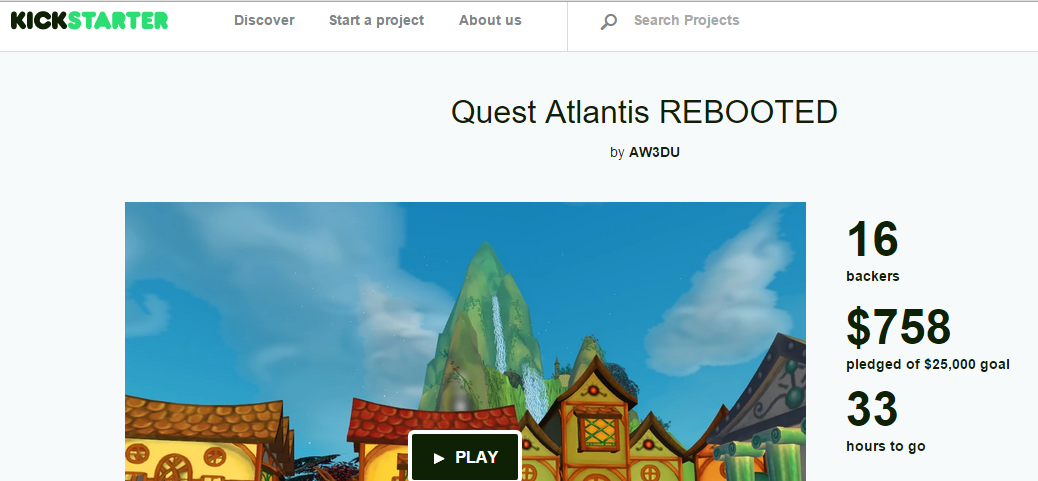
Bron Stuckey is supporting a campaign to reboot Quest Atlantis, a project derived from Active Worlds which she has been intensively involved in. She will join us on Learning2gether to tell us about the importance to learners of Quest Atlantis and the Kickstarter campaign she is promoting to help raise funds to revive the initiative, as it says on these websites
Rick Noll Owner and one of the developers of ActiveWorlds, Inc.
and Ellen Jameson of Reboot Quest Atlantis
For the past decade there was a vast educational research project taking place in classrooms on 6 continents. It was Quest Atlantis, a massively multiplayer online game integrating strong support for 21st century skills into each subject. Teachers, students, and researchers alike hoped that Quest Atlantis could grow, and other students could share the experiences they loved. Some parts of the project moved forward, but as grant funding for the multiplayer platform drew to a close, the team couldn’t keep the game ready for today’s classrooms. As the developers of the engine that ran Quest Atlantis, we’ve always been excited to see what students were able to do, inside the game and out, and we listened when teachers told us they didn’t want to see it go. We’re working hard to bring it back for a new generation, in collaboration with members of the original Quest Atlantis team. If you brought your students in to Quest Atlantis – or if you were a student there – you know that the community formed around reading, writing, building, sharing, and saving the world together was special. You know there was potential for much more to unfold – more for students and teachers to create, more features to make the right tools available. Make your pledge and help us bring a new Quest Atlantis to a new generation!
Where? Hangout on Air
You could watch and listen to the stream in the video embedded at http://webheadsinaction.org/live
while chatting with us in real-time in the Chatwing embed below the video
Vance Stevens – I see an icon with your name on it … move your mouse to the left edge of the HoA window and find the green screenshare icon with the white arrow, try and toggle it off ?
but if you’re happy, no problem
Daniel F. Bassill – I clicked on the green icon and it was inviting me to share my screen. I can see that in my icon space my screen is being shared. It’s not a problem to me.
Daniel F. Bassill – This issue of funding continuation is something I’ve focused on for nearly 20 years. I faced it in the programs I was leading and recognize that everyone else faces same challenge. Thus my on-line connections seek people working to fix this problem for all of us, not just for themself. Hard to find such people.
Vance Stevens – I think this is for K-12, am I right?
Daniel F. Bassill – Minecraft seems to be well-supported, and promoted, by YouTube videos that show “how to” build things. My son has watched these for a few years. Building something that has the same appeal, and the same level of YouTube activity, would be key to making this widely used.
Daniel F. Bassill – People need to get paid in order to stay involved and give their time and talent. Is there a business plan that shows how fees for use might generate enough revenue for future development, training, marketing, etc.
Ellen Jameson – Yes! Would love to talk more about that
Daniel F. Bassill – I’ve been part of some cMOOCs over past few years, such as Deeper Learning, Education Technology & Media. Format is good and can be on-going.
Daniel F. Bassill – Minecraft has millions of users who have become self motivated to spen countless hours playing the game. If educators had resources that motivated as much student use, and could show measurable learning outcomes, this would be a home run. It’s possible that the more this appeals to educators the less it will appeal to learners.
Ellen Jameson – That’s one reason I’m very excited about the story/game authoring tools. The thing that really drove the continuing core of voluntary student participation was building
even the peer review activity system was tied to building
And authoring is highly enriched building – as Bron described with World Congress
Nellie Deutsch, Ed.D – You need to market QA. I forgot about it until now. Need to bring it out to the public not just teachers, but maybe parents and kids
Daniel F. Bassill – I encourage you to move quickly into social media and/or a MOOC and try to attract those 25k past users into participation. Just building those numbers can help you demonstrate value to potential donors/investors while offering loads of talent to help you.
Nellie Deutsch, Ed.D – I’d like to get involved. I’m freer these days so try me.
The ELT cyber faculty lounge returns as many teachers and students around the world get ready to head back to the classroom. All are welcome to join in and share ideas, questions, and collaboration thoughts for the coming semester.
Wed. Aug. 26 1300 UTC
Tune in at http://eltlive.com/live
On Sunday August 23 Learning2gether met online with Jim Buckingham and Tony Waterman, teachers at Zayed University in UAE and at a defense academy in Muscat, Oman, respectively, to talk about innovation and mindset in teacher professional development and about Jim’s proposal that TESOL Arabia take on board his proposal for an online PD tutorials project.
Here are Jim’s notes on his proposal for the TESOL Arabia Online PD Tutorials Project
Pursuing ISTE Seal of Alignment
Jim has made contact with ISTE Standards – Senior Project Manager Mindy Frisbee to learn more about how any online programs or resources that we might realize could be awarded an ISTE Seal of Alignment. The idea of pursuing this is driven by a desire to have our work “internationally recognized” so that it has greater credibility in the eyes of both TESOL Arabia members AND those of us who will help realize these. By addressing such standards, we should gain some much valued and highly relevant PD.
Identifying / Contacting those involved in a Similar Project
There is also an Edtech Project (led by Carolyn Sykora) that is currently being supported by various Ministries of Education in the Gulf. The project – better known as ABEGS – is designed to provide sustainable support and training for up to 1.3 million classroom teachers on the effective use of technology and digital resources for learning across the whole of the GCC.
Ready or not, here they come! We reveal the key trends, challenges, and developments in technology that are poised to disrupt academic and research libraries worldwide in this free, virtual event.
You’re invited to the official release of the NMC Horizon Report > 2015 Library Edition — a collaboration between the NMC, University of Applied Sciences (HTW) Chur, Technische Informationsbibliothek (TIB) Hannover, and ETH-Bibliothek Zurich. Enjoy a front row seat to this “talk show” style event as the co-principal investigators of the project explore the findings from the report. Topics will include improving the user experience of libraries’ offerings, the evolving nature of the scholarly record, and makerspaces — among many others. Library professionals, join us to learn insights to continue advancing applications of technology at your institution.
The full list of topics selected by the expert panel for this year’s report can be viewed here.
Phil Hubbard joins Vance Stevens to discuss how the team at CPI (Courseware Publishing International in Cupertino California) developed Traci Talk and envisaged its use. The session was instigated by Sherry Schafer, an ESL professional with research interests in pronunciation and vocabulary teaching, who wrote us for more information after reading about Traci Talk, saying that “It seems like a very innovative program due to the integration of speech recognition technology. Also, the video game aspect of it seems to be very appealing and motivating to L2 users.” She will contribute her insights having used the program with some of her ESL students.
More generally we’d like to open up a discussion about whether there’s a place for interactive participatory dramas these days in language learning. Are there apps out there now that do something similar (branching dialogues with voice)? Would it be possible (or better) to have something like this embedded in a virtual world or other environment? Could a chatbot be programmed as a suitable “suspect”?
Hideto D. Harashima, H. (1999). Traci Talk – The Mystery. Software Review, Computer Assisted Language Learning, 12:3, 271-274. Available: http://dx.doi.org/10.1076/call.12.3.271.5708.
Hubbard, P. (2002). Interactive Participatory Dramas for Language Learning. Simulation & Gaming,33: 210-216. Abstract: http://dl.acm.org/citation.cfm?id=633603.
You are involved in a plot … In this program, you are asked to solve a mystery by taking a train to “Cupervale” and posing as a visiting professor at Cupervale University. The person who requested your help has arranged for you to meet one suspect on the train to Cupervale, and for another to pick you up at the station in his cab. You are taken to your apartment where your neighbor is a third suspect, you meet a fourth at a dinner party, and so on.
The plot thickens … As you meet each character you have the opportunity for an extended conversation that can take many paths. You are able to talk to the characters using a microphone attached to the computer. In so doing, you are exposed to a large amount of natural and communicative English, which you hear, but can also see in text form if you wish. Many of your utterances are recycled in the program to reinforce learning.
Learn English while solving the mystery … At the beginning of the program, there is a basic training session where you can practice. Or, you can start conversing with the characters directly. Repeating the conversations allows you to obtain additional information by following the many different paths. When you feel you know each of the characters you can go to the next level by answering a series of 8 questions correctly (taken randomly from a pool of 60). If you pass this test, you can invite the suspects to your place for a chat and try to solve the mystery!!
Sophisticated, humorous, and satisfyingly rich in content, the story line has been designed to appeal to adult learners and engage them in an interesting and fruitful language learning experience
There are endless ideas for engaging learners online. However, turning those ideas into activities that can be implemented smoothly is a challenge. There are many details to consider, and potentially overlook!
The idea for this SCoPE seminar developed through reflections on a series of online workshops for educators across the British Columbia post-secondary system. In these workshops we experience the benefits of developing and testing online learning activities in a supportive but critical community of peers. It’s time to open up those opportunities to everyone!
During this 2-week seminar we will explore, discuss, and create engaging online learning activities together.
Week 1: Exploring Options, Selecting Approaches Week 2: Building and Testing OLAs
There are two webinars scheduled as part of this 2-week seminar discussion. They will take place in the SCoPE Blackboard Collaborate Room: http://urls.bccampus.ca/scopeevents. As always, the synchronous sessions will be recorded for those who are unable to attend.
This presentation updates earlier ones on how to use the voice affordances of iPads and other mobile devices to make writing as well as teaching writing and giving feedback increasingly easier and more effective when students are using such devices than when voice tools are not appropriately enlisted. The presenter learns more every day about how to use these tools in teaching, and here he conveys what he has learned in hopes it will help other teachers of writing whose students are challenged when trying to write effectively on mobile devices.
Sat Aug 1 1430 UTC Wes Fryer and Amy – STEAMseeds11: Lesson Ideas with Vanessa Perez
Join Amy and Wes as they interview Vanessa Perez, an amazing, energetic, inspirational and always-sharing teacher at Tomlinson Middle School in Lawton, Oklahoma. Vanessa will share some of the STEAM lessons she’s done with students in the past as well as lessons she’s planning for the upcoming school year. She’ll also discuss her strategies for success writing small grants for classroom supplies and furniture, as well as share about her innovative classroom space designs. Vanessa recently started a #notreadytour Challenge for teachers on http://discover.oklaed.us and will talk about the goals for the project as well as how it’s going. Please join us for an hour of great Saturday professional development on August 1st!
There are endless ideas for engaging learners online. However, turning those ideas into activities that can be implemented smoothly is a challenge. There are many details to consider, and potentially overlook!
The idea for this SCoPE seminar developed through reflections on a series of online workshops for educators across the British Columbia post-secondary system. In these workshops we experience the benefits of developing and testing online learning activities in a supportive but critical community of peers. It’s time to open up those opportunities to everyone!
During this 2-week seminar we will explore, discuss, and create engaging online learning activities together.
Week 1: Exploring Options, Selecting Approaches Week 2: Building and Testing OLAsThere are two webinars scheduled as part of this 2-week seminar discussion. They will take place in the SCoPE Blackboard Collaborate Room: http://urls.bccampus.ca/scopeevents. As always, the synchronous sessions will be recorded for those who are unable to attend.
Wednesday, August 5, 2015 – Exploring Ways to Create Engaging OLAs
Thanks to Carlos, Gina, and SylviaC for participating and sharing their questions and ideas during today’s session. If you weren’t able to make it, you can watch the recording (including the occasional glitches). If you have any questions, just post in this thread. https://sas.elluminate.com/p.jnlp?psid=2015-08-05.0954.M.AC456DEF2B5841109A2E4E2783A336.vcr&sid=727
The next session isFriday, August 14, 2015 11:00 am – 12:00 noon PDT (see your time zone) on Sharing Our Creations
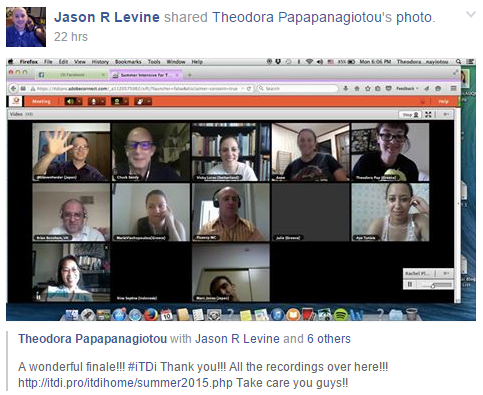
with a ten-day event featuring up to three presentations a day. This one was called Summer Intensive for Teachers and it started July 31, 2015 with the following event.
These events were free and they were archived, but in order to view archives, you must first sign up for a free iTDi account at http://iTDi.pro and agree to receive the iTDi Newsletter each month by email. Registration then grants you access to the archived recordings.
The record that appears here is to document what Learning2gether was up to at this time and for the convenience of participants in L2g in accessing the event after the fact. Please keep in mind that registration with iTDi is required to view the recordings and that the definitive archive is as noted above.
Fri Jul 31 iTDi Summer Intensive webinars begin with Juan Uribe
Date & Time
Presenter
Session Title and Description
July 31st
8 am GMT
Juan Uribe is a teacher trainer whose passion is studying & sharing how children learn languages affectively through play, games, storytelling, & puppeteering. He has been in an amazing journey visiting language schools for children around the world where he has both conducted teacher development programs as well as enchanted young audiences with Buddy the Frog. He writes a well-known blog called Children Learning English Affectively.
Special Preview Session
Being Affective Is Truly Effective!
Come learn how affective learning can engage and empower your students’ learning and your teaching. During this presentation we will explore how practical affective pedagogical practices can create nurturing mental models about student’s own learning, language uses, and their own linguistic competence. Join me in a journey with lots of play, imagination, and curiosity. Destination: language learning ownership.
Link to the recordings and chat logs are available at http://itdi.pro/summer2015.php
Create an account there to view both
Sat Aug 1 1330 UTC Jason Levine, Chuck Sandy, Scott Thornbury at iTDi Summer Intensive webinars
Jason R. Levine & Chuck Sandy
Opening Session Chuck & Jason welcome you to the Summer Intensive with news, updates, and prizes for those attending the session live. Learn more about the course and how to qualify for Certificates & Professional Development Credit from iTDi.pro
Scott Thornburyis a teacher and teacher educator, with over 30 years’ experience in English language teaching, and an MA from the University of Reading. He is currently Curriculum Coordinator of the MA TESOL program at The New School in New York. His previous experience includes teaching and teacher training in Egypt, UK, Spain (where he lives), and in his native New Zealand. His writing credits include several award-winning books for teachers on language and methodology, as well as authoring a number of papers and book chapters on language and language teaching. Scott is series editor for theCambridge Handbooks for Teachers (CUP), co-founder of the dogme ELT group and an associate of the International Teacher Development Institute (iTDi). Finally, here’s a link to Scott’s Amazon site.
-Opening Plenary –
Correct Me If I’m Wrong
Based on the speaker’s own recent experience of ‘de-fossilizing’ his Spanish, a case is made for the key role that correction (including explicit negative feedback) plays in boosting student achievement and enhancing teacher effectiveness. In our well-intentioned efforts to promote authentic communication in the classroom we sometimes overlook the one component of classroom interaction that distinguishes it from other forms of interaction, and which makes it especially effective: i.e. corrective feedback. In this class we will look at different options for the form, frequency and timing of corrective feedback, with special reference to oral production, and discuss how these might impact on learning.
Link to the recordings and chat logs are available at http://itdi.pro/summer2015.php
Create an account there to view both
Sun Aug 2 iTDi Summer Intensive webinar with Barbara Hoskins Sakamoto
What are 21st century skills, really? And, do they have any place in language class, where time is limited and the focus is on learning English? Fifteen years into the new century, researchers have had time to look at innovative teaching practices around the globe to identify those approaches make the greatest impact in preparing our students for life in the 21st century, and beyond. In this session we’ll look at teaching techniques that will help your learners become strong English users and also critical and creative thinkers. By making every moment of class time count, you can help your students succeed – whatever their future holds.
Link to the recordings and chat logs are available at http://itdi.pro/summer2015.php
Create an account there to view both
Sun Aug 2 iTDi Summer Intensive webinar with Alexandra Chistyakova
Alexandra Chistyakova is an English teacher at the Physics faculty of Moscow State University, Russia. She also works as a freelance teacher giving one-to-one English lessons to the large range of learners: from preschoolers to senior adults. She’s always been engaged in the continuing professional development, taking teacher-training courses, studying specialized literature and taking part in ELT conferences and seminars. She received her CELTA at BKC-in, Moscow, in 2011. Her professional interests include: professional development, ELT methodology, teaching 1-2-1, and language course design.
A Journey into the World of ELT Methods
All aboard! Our hot air balloon is departing soon! We are going to take a nice ride across the vast world of ELT methods, looking at the most prominent and the most interesting ones from the height of our experience and knowledge. As we go from one method to another we will consider the benefits each approach can give and will pick up some practical ideas of how to make the most of the existing ELT methods in our classrooms.
Link to the recordings and chat logs are available at http://itdi.pro/summer2015.php
Create an account there to view both
Mon Aug 3 iTDi Summer Intensive webinar with Barbi Bujtas
Barbi Bujtas is a freelance EFL instructor in Hungary. She has been teaching for 15 years in various teaching environments from one-to-one to high school, depending on local demands. Her professional interests are dogme, ICT, engagement, materials design, teachers’ communities.
Fake it till you Make it Do you know this huge gap between what your students want to say and what they can say in English? Nowadays technology allows you to create cool videos in which your students actually speak a level of English far beyond their actual stage in their interlanguage. They are based on their ideas and choices, which means an ownership of their learning, it also means a higher level of motivation and more effort than usual. The end product shows them a possible future self that can say what they want in English. This session shows you some examples and ideas of how to use ‘fake it till you make it’ video projects with young learners.
Link to the recordings and chat logs are available at http://itdi.pro/summer2015.php
Create an account there to view both
Mon Aug 3 iTDi Summer Intensive webinar with Theodora Papapanagiotouis
Be Different! Are you bored with the traditional foreign language lesson? Tired of performing your lessons based on a course book? Have you ever thought of integrating your students’ personalities and interests in your teaching? In this presentation I am going to show you how my last year has been, trying out revolutionary methods in my classrooms, using the differentiated instruction approach and blended learning.
Link to the recordings and chat logs are available at http://itdi.pro/summer2015.php
Create an account there to view both
Tue Aug 4 iTDi Summer Intensive webinar with Kevin Stein
August 4th
1 pm GMT
Check your local time
1 pm Kevin Stein is a high school teacher, curator of the iTDi blog, and singer of silly songs. He also believes in the power of students to find their own path forward and the importance of relationships in building a community of learners, whether it be students, teachers, or a mixture of the two.
But That’s Not Literature, is it?
There is all kinds of literature out there in the world and much of it is just waiting to be used in a language classroom. In this lesson we will take a look at some short poetry and stories and explore why students might have difficulty engaging with and understanding ‘literature.’ Participants will walk away with some concrete techniques for helping students engage with a text and ideas for how to use literature as a jumping off point for classroom activities and conversations which can engage our learners on a deeper, more intellectually challenging level.
Link to the recordings and chat logs are available at http://itdi.pro/summer2015.php
Create an account there to view both
Wed Aug 5 iTDi Summer Intensive webinar with Shelly Terrell
Teaching the Emoji Generation Our learners are fluent in different languages, especially emoji! They translate, decode, read and write in emoji throughout the day. Join Shelly Sanchez Terrell for an active session learning emoji. We will also learn ways to get students motivated to learn English and improve their fluency by integrating text speak and emoji activities into our curriculum. We will also participate in icebreakers to help us effectively teach digital literacy and citizenship.
Link to the recordings and chat logs are available at http://itdi.pro/summer2015.php
Create an account there to view both
Wed Aug 5 iTDi Summer Intensive webinar with Tyson Seburn
Tyson Seburn
As an EAP teacher in higher education, Tyson focuses on meaningfully engaging students with their L2 reading to afford stronger application of academic writing skills. This led to authoring Academic Reading Circles(the round). As a teacher within the ELT community, he is driven to create new public spaces for and aid self-directed action among language teachers to increase agency in their own development paths. These have led him to his MA in Educational Technology & TESOL, writing at 4CinELT, and organizing #tleap.
Beyond the Comprehension Question: Digging Deeper into Texts While the comprehension question prevails in reading-focussed lessons as one tool for validating understanding of text concepts, supplementing it with learner-centred, co-constructive activities can engage students further and improve their comprehension. In this talk, we will explore ways in which we can complement this tool, by equipping learners with methods that encourage deeper questioning of a text and more collaborative interactivity with it. Activities from the book, Academic Reading Circles (the round), will be used and built upon so that participants will leave with enough ideas to adapt them to their teaching contexts.
Link to the recordings and chat logs are available at http://itdi.pro/summer2015.php
Create an account there to view both
Thu Aug 6 iTDi Summer Intensive webinar with Josette LeBlanc
Josette LeBlanc has been working with English language teachers in Korea since 2010. During this time, she developed an interest in reflective practice for professional development and writes about it on her blogThrowing Back Tokens. This experience also motivated her to research the topic of teacher well-being as many spoke of feeling unhappy and burnt-out. As a result, she now curates a website,www.redthumbforlove.wordpress.com, where teachers from around the world share their stories and strategies for self-care and self-compassion. You can find her on Twitter at@JosetteLB or on Facebook at,KMU-SIT Professional TESOL Certificate.
Play Big: Start Small You may have heard ofS.M.A.R.T. action plans when it comes to creating lesson objectives or teaching goals. Although “smart” in theory, these action plans may leave teachers feeling dissatisfied to the point of inaction. One way to change this is to turn S.M.A.R.T. into a S.M.I.L.E. Based on research in neuropsychology and personal development, S.M.I.L.E. is an approach to action planning that can relieve the weight of overwhelm or perfectionism, and enhances our sense of satisfaction. During the session, we will examine this approach in order to develop the type of teaching practice we desire.
To access recordings, sign up for a free iTDi account at http://iTDi.pro and agree to receive the iTDi Newsletter each month by email.
Link to the recordings and chat logs are available at http://itdi.pro/summer2015.php
Create an account there to view both
Thu Aug 6 iTDi Summer Intensive webinar with Divya Madhavan
Divya Madhavanis a Senior Lecturer in Language and Education at Centrale-Supélec, Université Paris-Saclay. She teaches English language courses, and lectures on Education and Society. Her areas of research include, Critical Pedagogy, Assessment and English as a Medium of Instruction. She is the current Website Editor for the IATEFL Teacher Development SIG and an iTDi Mentor. Divya has just completed an MEd in Education Research, and has an MA in Language Education. She is also a Fellow of the Royal Society of Arts.
Action Research and Your Teacher Voice This session is a step-by-step description of what an action research project looks like, from broad questions like “why do it?” to specific questions like “how can I write up data?”. This will be your chance to talk to me and other people interested in action research, and think about why you might want to become an action researcher.
Link to the recordings and chat logs are available at http://itdi.pro/summer2015.php
Create an account there to view both
Thu Aug 6 iTDi Summer Intensive webinars with Debbie Tebovich
Debbie Tebovich is a freelance English Language Trainer and iTDI mentor based in Buenos Aires, Argentina. She has been teaching English for over 20 years and teaches General English and Business English on a 1-1 basis online and offline.She is passionate about teaching and learning and she is a technology enthusiast to create memorable learning moments. Above all, she strongly believes in the power of Education to transform people’s lives, to help and encourage freedom of thought and to develop bonds to make our world a better place for all of us and for future generations.
Unplugged Goals and Outcomes
How can we predict goals and outcomes when we ditch lesson plans? How can this free us up and allow learners to lead the journey? As connected educators, we will explore these questions from a Rhizomatic Learning perspective. I will share an example of a real Business class which emerged as we started searching for answers to my learner’s feelings and questions.
Link to the recordings and chat logs are available at http://itdi.pro/summer2015.php
Create an account there to view both
Fri Aug 7 iTDi Summer Intensive webinar with Luke Meddings
August 7th
1 pm GMT
Check your local time
1 pm Luke Meddings is an award-winning author, international speaker and teacher trainer. In 2000 he co-founded Dogme in ELT with Scott Thornbury, and their book Teaching Unplugged (Delta, 2009)won a British Council ELTon award in 2010. He co-founded e-publishing collective The Round with Lindsay Clandfield in 2011, and their book 52: A year of subversive activity for the ELT classroom, was published in 2012. 2015 will see plenaries in Mexico, Greece, Ireland and Malta.
Punctuation Marks?! Exploring Learner Stories and Teacher Interventions in the Unplugged Classroom… Teaching unplugged means responding to information, eliciting contributions and offering on the spot language help and advice. This session uses punctuation marks as an analogy for different kinds of teacher intervention – both during conversation, and when conversation is paused for language development. Punctuation may not carry the content of a text, but it helps to make sense of it – and these little marks are an essential part of the story.
Link to the recordings and chat logs are available at http://itdi.pro/summer2015.php
Create an account there to view both
Fri Aug 7 1500 UTC iTDi Summer Intensive webinar with Karen Frasier Tsai
Karen Frazier Tsai
earned a BA in Speech, with an emphasis on Speech Pathology, and an MA in Linguistics. She has over 30 years’ of EFL/ESL experience, at various levels, in Taiwan and the U.S. Karen conducts teacher-training workshops, online presentations, and currently helps provide international people of all ages with a variety of English learning opportunities in Seattle WA, including a story-time for international toddlers & mentoring international mothers about reading to their toddlers in English. She also serves on a school district committee that is setting updated guidelines to ensure all students succeed in school. She is co-author of Let’s Go, one of the world’s best-selling English courses for children, published by Oxford University Press. Sheblogs at Teaching Children English,
Children Playing with Words
Play is a fundamental way that young children learn. Child’s play is also a valuable tool that can be utilized to help students learn the rudimentary skills they need to begin reading. Blocks, rebus words, word cards, flannel posters and more can be used to create an understanding of the English sound/spelling patterns and simple word families.Learn about some hands-on activities, which creatively engage young learners and are designed to build phonemic awareness, knowledge of phonics and beginning reading skills.
Link to the recordings and chat logs are available at http://itdi.pro/summer2015.php
Create an account there to view both
Sat Aug 8 iTDi Summer Intensive webinar with Vivian Wang
Vivian Wang M.A. English and American Literature, B.A. English Language, Linguistics and Literature, is an experienced teacher with thirteen years of teaching experience. She has taught practically every age group, from toddlers to adults, and has worked for private language schools, high school and educational corporation. She is a certified trainer of Oxford Teacher’s Academy. She has also been a university instructor for seven years. Vivian is particularly interested in skills of motivating students in learning English. She currently teaches in Shih Hsin University, works as ELT Trainer (Taiwan) for Oxford University Press, and continues to enjoy sharing ideas with teachers.
Teach English Within a Framework of 21st Century Skills
We live in an age of rapid change. Students in the 21stcentury need to do more than acquire information. The way we teach needs to take into account the students that are in front of us, the skills they have, what interests and motivates them and, perhaps most importantly, what we can and should offer them. This session is for teachers who believe that learning and creativity go hand in hand; and for teachers who want to spice up their curriculum, break the mold and meet the needs of 21stcentury students.
Link to the recordings and chat logs are available at http://itdi.pro/summer2015.php
Create an account there to view both
Sat Aug 8 iTDi Summer Intensive webinar with A.K. Syke
SYKE A.K. holds a Bachelors of Education as well as a Masters in English, and has been teaching English for the past 13 years in high schools and universities in his home state in India. He is an iTDi Mentor, presenter, materials writer and a coordinator/host of webinars and virtual conferences. Syke has presented papers at many national and international conferences.He spoke at the Associates’ Day of IATEFL Manchester 2015 , representing the ELTAI.
Teaching English Through Poetry of Other Languages Poetry is definitely the soul of a language ….an embodiment of its cultural identity.. Have you ever thought of using poems in other languages in your English class room ? Here, I would like to show you , how the poems in L1 or L3 can be used effectively in an ESL classroom.
Link to the recordings and chat logs are available at http://itdi.pro/summer2015.php
Create an account there to view both
Sat Aug 8 iTDi Summer Intensive webinar with Matthew Noble
Matthew Noble is a teacher and teacher trainer from Boston, MA who joined the ELT field as a volunteer in Sri Lanka in 2004. Since then he has taught children and adults abroad and in the US, helped train new and experienced teachers F2F and online, and discovered the wonderful world of web-based professional development at iTDi and elsewhere. He’s thrilled to be a part of this amazing event for a 2nd time and looking forward to learning and sharing along with teachers all over the planet this summer! Tweet him here.
There are things we don’t know we don’t know, things we know we don’t know, things we know we know, and things we don’t know we know. Ya know? Come explore the use of an intuitive skills acquisition process matrix to sketch, stretch, scaffold, and vitalize planning, teaching, and learning. Sound a bit theoretical, perhaps even a pinch poetical? Well, it’s both…but extremely practical applications are also guaranteed! 🙂
Link to the recordings and chat logs are available at http://itdi.pro/summer2015.php
Create an account there to view both
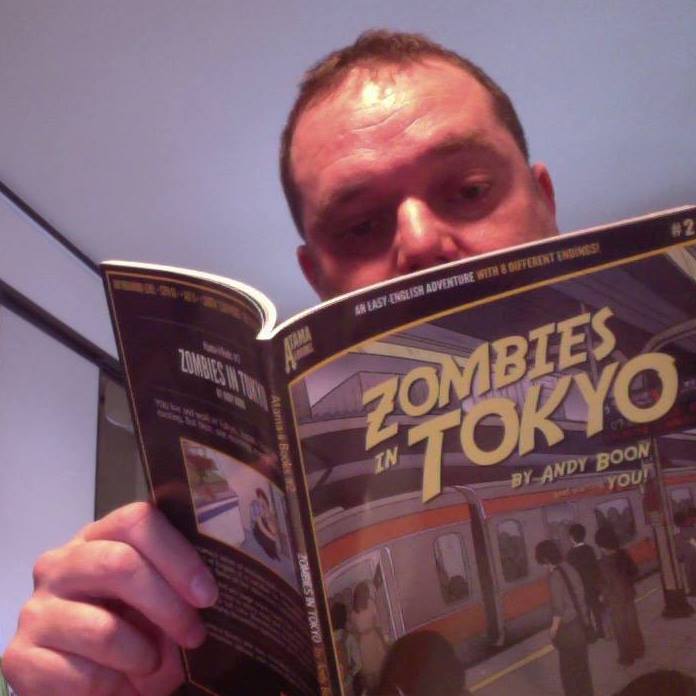
Sun Aug 9 iTDi Summer Intensive webinar with Andy Boon
Andy Boon is an associate professor at Toyo Gakuen University, Japan. He has been teaching for over 17 years and is near completion of a PhD. He has presented at many conferences, and has published articles on teacher development, motivation, ER, and methodology. He is the co-author of textbooks – Discover the News (Language Solutions, 2013), Inspire (National Geographic Learning), author of Research & Write (Macmillan), and author of various graded readers (Macmillan and Atama-ii).
Setting up an Extensive Reading Program: The Beginning, the Middle, and the End This session will provide an outline of how to set up an extensive reading (ER) course or program at your school. It will describe how you can orient students to ER, how you can finance ER, what students can do in the ER classroom, how you can assess ER, and how ER can help to improve your students’ English.
Link to the recordings and chat logs are available at http://itdi.pro/summer2015.php
Create an account there to view both
Sun Aug 9 iTDi Summer Intensive webinar with Steven Herder
Steven Herder has been teaching within the Japanese EFL context for over 25 years. Having many years teaching experience at the elementary and junior/senior high school level, he is currently an assistant professor in the Department of International Studies at Doshisha Women’s College of Liberal Arts, teaching TOEFL iBT preparation, and a 3rd/4th year seminar on Exploring Leadership.He is an author and editor of two Palgrave Macmillan teacher resources, Innovating EFL Teaching in Asia (2012) and Exploring EFL Fluency in Asia (2014). In 2012, he and a network of like-minded educators co-founded the International Teacher Development Institute (http://itdi.pro), an online community for teachers by teachers, with over 5000 members and a global reach into over 100 countries.
Online Tools that Spur Improvements in TOEFL iBT Essay Writing Japanese students planning to study abroad at a foreign university for a year need to score significant points in the TOEFL iBT or IELTS exam. Over the past 5 years, I have helped hundreds of students improve (to varying degrees) their essay writing for such a standardized test. In this session, I will share approaches and techniques that have been the most successful to date. These include collaboration, fluency, reflection, data analysis, cohesion, coherence, and error correction.
Link to the recordings and chat logs are available at http://itdi.pro/summer2015.php
Create an account there to view both
Sun Aug 9 iTDi Summer Intensive webinar with Rose Bard
Rose Bard
has been an English teacher in Brazil for more than 17 years. She’s an iTDi MENTOR/BLOGGER and the CO-Moderator of BRELT FB community. She’s been actively learning and sharing online through her blog ELT Diary and PD opportunities since 2012, and also with and from iTDi community.
Creating Activities with GForms
Have you ever used Google Forms? Have you ever thought of using them to expand the contact hours with English which learners need to continue improving their reading and listening skills as well as their language knowledge? GForm is a free online tool that can be easily embedded in other free online spaces (Wiki, Blog, Google Site, etc.) . In this session, let’s look at the possibilities of using GForm to engage, support, test and collect feedback in order to make homework more interesting to learners and personalize learning.
Link to the recordings and chat logs are available at http://itdi.pro/summer2015.php
Create an account there to view both
Mon Aug 10 iTDi Summer Intensive webinar with Jason Levine
Jason R. Levine
is Ambassador and Knowledge Entertainer at Gallery Languages, where he conducts webinars and workshops for English students and teachers at schools worldwide. He is the creator ofColloLearn, an approach to English language learning based on the songs he writes and performs as Fluency MC. He also writes songs and chants for several publishers, including Oxford University Press. As an English Specialist with the U.S. Department of State, Jason has led teacher training programs in fourteen countries in Europe, the Americas, Africa, and the Middle East.
Practice Makes Perfect…Perfect Opportunities to Use English
Practicing English, like practicing a sport or a musical instrument, leads to accurate and fluent performance. Yet most English learners do not get the practice they need to use English with confidence in or out of the classroom. As a result, they lose motivation. In this talk we will discuss what we can do as teachers to help students get the language practice they need to achieve their communicative goals.
Link to the recordings and chat logs are available at http://itdi.pro/summer2015.php
Create an account there to view both
Mon Aug 10 iTDi Summer Intensive webinar with Vicky Loras
Vicky Loras is an English teacher,born in the beautiful city of Toronto, Canada. She has been teaching English as a foreign language and literature to students of all ages, since 1997. She now lives in Switzerland and she is the co-founder and owner ofThe Loras English Network, a school she has opened with her sister Eugenia. They teach English, train teachers and also hold children’s events.
Not Only Staying Afloat, But Also Making Waves There are a lot of teachers around the world, more than ever, who have to face a lot of difficulties when teaching – budget cuts, restrictions, little or no support from their administrators. Do they give up? No – and they do much more! We will look at this wonder of educators and what they do.
Link to the recordings and chat logs are available at http://itdi.pro/summer2015.php
Create an account there to view both
On Sunday July 26 Vance took time off from celebrating the wedding of a son in Penang to moderate a Learning2gether webinar on Tandem MOOC. Sabrina Wilson had arranged for Ljubica Damevska to join us on Learning2gether to talk about her analysis of transactions between English and Spanish native speakers participating in Tandem MOOC.
Ljubica is a CELTA qualified English teacher and Master’s degree student at the University Rovira i Virgili in Tarragona, Spain. Ljubica is interested in online language learning, particularly in the new trend of Language MOOCs. She is currently working on her final project on Tandem MOOC under the tutelage of Dr. Christine Appel, one of the coordinators of the Tandem MOOC project and the director of the eLearn Center at the Open University of Catalonia (UOC). Twitter: https://twitter.com/RitaEtMachin
Foreign Language Massive Open Online Courses (LMOOCs) are a fairly new educational model emerging from the rich, flexible, collaborative, and social interactive nature of Massive Open Online Courses (MOOCs). Tandem MOOC is a free LMOOC developed by the Universitat Oberta de Catalunya (UOC), Universitat de Barcelona (UB) and Universitat Rovira i Virgili (URV). The course took place at the beginning of November and lasted six weeks. Students, who took part in Tandem MOOC, could improve their speaking in English or Spanish with native speakers of the language they were learning. The novelty of Tandem MOOC lies in its focus on communicative activities developed by students. In the Tandem MOOC platform students used video chat tools and a system that paired them up automatically with the partner of the foreign language they were learning. Every week, students solved communicative activities in tandem and feedback was provided by their native tandem partners.
Tue July 21 0100 GMT ELT Live Hangout with Jeff Lebow
Time for the hiatus to come to an end and discuss possibilities for ELT Live Hangouts and other online gatherings with Language Learners and Educators. Tune in and join in at: http://eltlive.com/live
Tuesday, July 21 0100 UTC Global Times: http://bit.ly/1M98Kwn
All are welcome to join in and discuss what’s on their ELT plate right now – reflections on past semesters, plans for upcoming courses, possibilities for student learning exchanges, or anything else.
Learning2gether hitched a ride this weekend with the webcastathon 5-day 30 Goals free online e-conference. The event was smoothly staged with a simple web portal containing a promotional video, a schedule with tabs for each day and links to each presentation URL, a Chatwing text chat, and a Twitter feed display. There has since been added a Padlet for graphic reflections
Each presentation had a page where the speaker was introduced and the topic described. There was a Hangout on Air video embed there which streamed while the presentation was active and archived and played the recording moments after it was done. As with http://webheadsinaction.org/live, there was a Chatwing embed below that where participants could chat during the presentation and carry on the conversation after the event. The conversation pages were quite active for every presentation and can be viewed from the links at the conference portal, and for the convenience of readers of this blog, at the Recording links below.
This was a similar interface to what we use with Learning2gether Hangouts on Air, and it modeled a great interface for attending an online conference. As with L2g events, I recommend to participants that they open the Chatwing text chat in a separate window to the one with the video stream, to be better able to follow both at the same time. This is what it looked like to me.
This screenshot shows how the chatwing is open in a separate window for viewing the stream and chat at the same time
The conference started with a kickoff event on Thursday. Friday was officially Day 1 of the conference, which ended Monday on Day 4. Here is the play-by-play with recordiings:
Fri July 17 – Day 1 of the 30 Goals free online conference
Reflect Through a Blog Sue Waters @suewaters
Join us for a workshop to help you reflect through blogging! During this session you’ll learn helpful tips to get you started blogging or to take your blog to the next level. You can check out her personal educators blogging series here:
My Students Are My Champions! María J. García San Martín @mjgsm
With the aim of sharing how I accomplished the ‘Be someone’s champion’ and ‘Plant a Seed of Belief’ goals with my students, I’ll be talking about how my students have become my champions and it’s actually them who’ve planted a seed of belief and enthusiasm in me, as they bring the best of me as a teacher when I see them grow, improve and connect.
Mobile Devices & Productive Classroom Collaboration
Raquel Gonzaga @Rach_Gonzaga
In this keynote, I intend to share with the audience the successful experience of having students(adult and teenagers) enhance their lexical and communicative skills by collaborating in real time using the app Google Docs in their mobile phones.
I will show the evolution of their first drafts and attempts to their current usage and how that has impacted their written and oral production.
Is Talent a Myth? Sylvia Duckworth @sylviaduckworth
Are we born with natural talent or can we develop skills with determination and hard work? Drawing inspiration from the book “Bounce” by Matthew Syed, Sylvia will explore this question while she describes her journey from non-artist to sketchnoting fanatic.
At its core, the 30 Goals Challenge inspires teacher development individually and as a connected group, in either order and for both ends. This same reflexive process beautifully draws students into their own learning—a reminder this talk will explore and exemplify.
The Impact of a Goal & The Vigor to Overcome Obstacles!
Cristina M. Silva @cristimsilva
One of the 1st cycle goals impacted the way my teaching evolved and changed. This keynote unveils this story and illustrates it with practical examples of what transformed in my classroom and motivated me to keep searching for better ways to engage in a 21st century teaching approach, providing the students with 21st century skills. Obstacles? We can handle them, because we are teachers!
I Have Critical Moments for Breakfast David Dodgson @DaveDodgson
Critical Moments’ can strike at any moment, often when we least expect them. Recognising and embracing such moments is one of the best ways for teachers to develop. In this talk, David will tell us about four short stories of key critical moments from his career, starting with his breakfast.
Teaching Children With Mascot-Inspired Projects Malu Sciamarelli @malusciamarelli
In this talk, I will explore some basic features of project-based learning and show an example with the fluffy toy Brownie the Bear and its friends. Based on this project, teachers will be able to create and elaborate their own original and creative projects with a mascot of their choice.
Let’s Get Loud! Turn the Music Up! Maria Bossa @mariabossa
Music, one of the greatest motivators in class, has a lot of power when we add movement and action. I will provide activities to do in class with different pop songs.
Have We Closely Mirrored? A Balanced Reflection of Our Teaching Practice
Johannes Rojas @jodaro87
In this keynote, teachers will get a glimpse of a balanced teaching practice reflection based on the reality of the educational contexts involved. Teachers will also get the chance to reflect on their own practice (what they did, do and intend to do soon enough), check out their teaching identity (“I am teacher so what?”), reasons for keeping on teaching (Is there any?) and become aware of the changes they are able to make with just a tiny purpose and teaching passion. Teaching must be anchored to a variety of changes led by the context need, providing the adaptability it demands to make of it a teacher-student successful experience despite the cons it faces; resources, payment, low salaries and many other situations can break down all projects, but teachers need to be reminded that those things will not be embraced differently if they do not start making a difference on themselves.
Impact of social media on students’ communication skills
Rusul Alrubail
Have you ever wondered if texting, tweeting and snapchatting impact our students’ communication skills in the classroom? Well, they certainly do! This session will introduce different social media tools that students use for social communication and will explore the impact they have on their oral and writing communication in the classroom. Effective strategies will be discussed on how to manage this Impact and help students communicate effectively.
Sat July 18 – Day 2 of the 30 Goals free online conference
The Power of a PLN Nikki D Robertson @NikkiDRobertson
Join Nikki to learn how she went from a veteran educator in a rut doing the bare minimum to collect a paycheck to a renewed invigorated educator through connecting with Shelly Terrell’s 30 Goals Boot Camp and building a PLN through Twitter.
NuSkool: Real life learning & science of student engagement Abran Maldonado @Aronic_MCPhD @NuSkool
Abran will give a keynote on NuSkool’s method of transforming pop culture into a learning experience. NuSkool finds teachable moments in all forms of entertainment, from TV to music and video games, creating lessons schools can use to engage struggling students. This subscription-based online platform allows teachers to create virtual classes, providing access to lessons based on trending topics that matter most in students’ lives. It’s relevant, real life learning.
Unity, Coherence, and Cohesion: The Keys to Better Academic Paragraph and Essay Writing Rosmery Ribera Ferrier @teacherroscba
In this keynote, Rosmery will show you how to teach students the keys to better academic writing- Unity, Coherence, and Cohesion. Participants will walk away with teaching guides and skeletons (writing outlines).
Beyond “We should do something about that”: Actually Doing Something Noah Geisel @senorg
Identifying a problem is a great start. Inspiring yourself and others to care is good too. Taking action to solve the problem is often a missing link and one reason why I embrace the 30 Goals Challenge. We’re not here to get ready, we’re here to get started!
This presentation aims to share how I’ve achieved the goal of giving students reign by co-constructing our classes. Hear, Share, Ask! introduces three key principles to guide the process of negotiating the Whats, Hows and Whys to learn the language and developing skills.
You can grab the moment or you can let it pass. Ditch the plan.
Debbie Tebovich @datEnglish
How can we take learning to a different level? How can we bring some balance into planning and ditching the plan to bring real life, joy and fresh air into our class? How does trust benefit learning and teaching? We will explore these questions while I will share a story about how an event happening outside the walls of our classroom led us to an unplanned memorable learning moment.
Bouncing back! Resilience and survival as an educator
Jo Hart @JoHart
All the time I see Educators struggling to survive! Some of us do and some of us don’t. We stop teaching – change careers opt out completely OR we just hang in there! Why, and why, and what can we do to help us survive?
Silos and Connectivism: The Finnish Experiment Phil Hart @Philhart
Educational silos have been around for about a century. The damage that this does to students is only now being recognised. This session examines the changes that educators must embrace to eliminate that damage.
Sunday July 19 LEARNING2GETHER with Day 3 of the 30 Goals free online conference
The Human Touch Vicky Loras @vickyloras
There are various types of classrooms all over the world – their variety lies not only in the environment, but the classes, the educators and students. We know this either from seeing them, or hearing and reading about them in blogs, on social media and in our everyday teaching lives. Some have state-of-the-art equipment and everything an educator and students would dream of. Several have a few things that could assist the class in their learning, colourful walls and children’s work displayed on them. Some, however, have nothing at all, apart from dirt floors and bare walls. Why does this occur? How does this affect learning, if it does at all? What is the most important entity in the classroom?
Join me in a journey around the world, where we will be on a quest to search for where the importance lies.
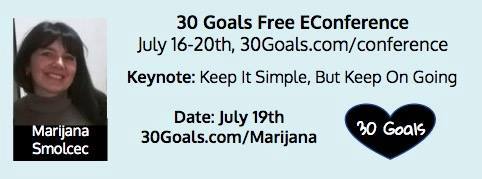
Everyone can achieve certain goals set for themselves, whether they are small or big, whether they are difficult or easy, we just need to keep it simple and keep on going. Never give up! In this short presentation we will share some suggestions about how to be a part of the overwhelming, but passionate EDU community. How to share, learn and motivate each other.
This is how we got Theodora to provide the link to Marijana’s slides.(Theodora was displaying the slides from her place in the Hangout.)
Help them SHINE! Playing Games When Teaching 1 to 1 Naomi Ganin – Epstein @naomishema
Students are not fools. They don’t believe the teacher who lets them win a game on purpose or pretends not to know the answer to the question. This talk will examine how we play games when teaching one-on-one, respecting the students but still helping them shine!
Explore.Create.Share- Be a Champion of Digital Citizenship André J. Spang @Tastenspieler
In this keynote, participants will learn how to help their students become great and responsible digital citizens who share and post online safely. Andre Spang will discuss the 4 C’s of 21st century learning and the Maker movement.
C.P.R. for the Drowning Teacher Sarah Thomas @sarahdateechur
PARCC. SLOs. Drowning in the alphabet soup? Learn how to bring new life to your teaching through the one acronym that just may save you, the C.P.R. method. Maximize productivity through COLLABORATION. Bring your PASSION to the classroom. Make your lessons more engaging through REINVENTION. Take a deep breath and dive in.
Teachers are often known as people who are always willing to help, go the extra mile to plan and teach lessons that will foster the learning and development of students. But many times that takes a toll, and it’s not unusual to hear about burnout teachers – some go as far as abandoning education altogether. In this talk I’ll share my experience, common symptoms and especially things you can “weave” into a protective suit to keep the “fire” away and prevent burnout.
Most of you would agree that being a teacher, does not only have to do with presenting a subject, but also be a role model and make students aware of situations and other people’s feelings. Could we raise students’ awareness? This is a presentation of a #30Goal that started as a blogpost and turned out to be a wonderful event.
The 30 Goals Challenge: Just When I Needed You Most! Fabiana Casella @FabianaLCasella
In this keynote, I share the reasons why I joined the 30 Goals Challenge, how much I have grown as a teacher since then, how being part of this community motivates me to go on teaching and innovate, as well as considering myself a continuous learner.
Too many students believe they don’t need to learn, or that they can’t learn. Professor Carol Dweck contends that this is due to students developing a Fixed Mindset with regard to their capabilities. Dweck argues that learning is stunted and many social issues can arise by having a Fixed Mindset. She says in order to students to flourish, they need a Growth Mindset – a disposition that embraces challenge, seeks out feedback and values effort as the pathway to mastery. Could a Growth Mindset be the key to unlocking our students potential, and how can teachers and schools cultivate a culture of Growth in their classrooms and schools?
In addition to this, research suggests that the teacher’s mindset has a significant impact on the students in their care. How can we address our mindset in order to challenge expectations and improve our ability to recognise potential and learning in every one of our students? In particular we’ll consider the theory behind mindset, as well as strategies for feedback and assessment.
Monday July 20 – Day 4 of the 30 Goals free online conference
Blogging for the 30 Goals: Reflecting on My Teaching & Learning Experiences
Vicky Papageorgiou @vpapage
Blogs are great ways of gaining confidence, practicing writing, and
participating in networks of other teachers or learners. How has my experience of blogging for 30 Goals for Educators helped me learn more about myself, improved my writing and introduced me to dedicated educators from all over the world?
When we complete challenges and develop as educators, we can see the result of our efforts in ourselves and our classes. But what would happen if we invited our students to take a challenge with us? Inspired by the 30 Goals Challenge for Educators, I asked students to join me in creating our video introductions to share with each other and the world. The idea, the interaction and the discoveries made our learning environment fun, engaging and safe and our journey even more worthwhile. This was our challenge.
Social Media for Student and Teacher Development Ayat Al-Tawel @ayatawel
Social media is not about collecting likes and followers. It’s about connecting to make a difference (Cress, 2013). This session will demonstrate how to make that difference with your students and for your own professional development with social media tools such as; FB, Twitter, Edmodo, Google + and Pinterest.
Focusing on the Learner First Barbara Bray @bbray27
I will share my story of being a creative, engaged learner when I was young and then how I became compliant to “do” school to get through school. I just didn’t fit, but I found my purpose. I will share the importance of finding our voice so we can own and drive our learning.
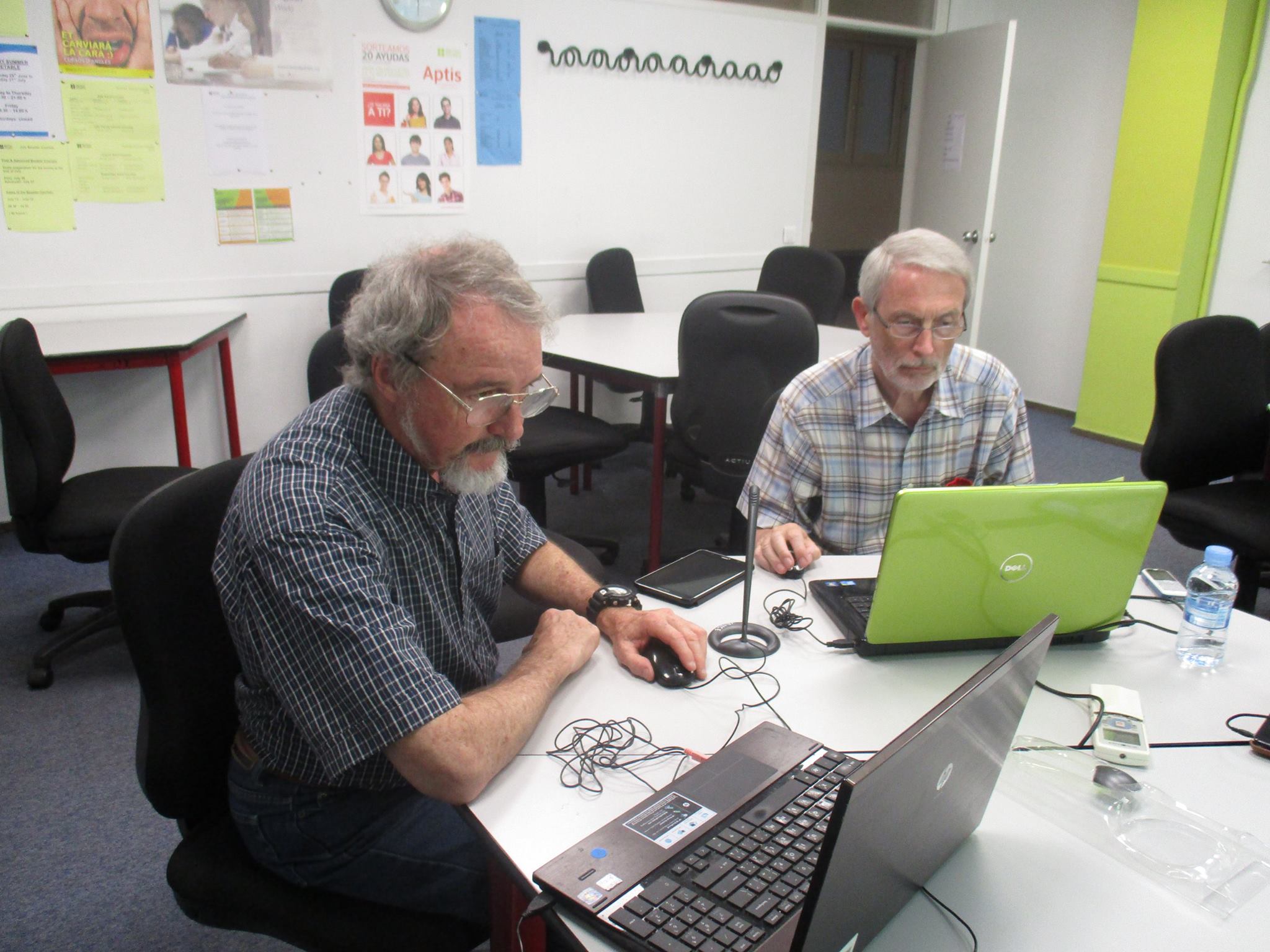
On Monday, July 13, Vance and Bobbi appeared at the British Council Amigo Center at 12:30 GMT to hear what Chris Fry had to say about Story Recording. The event was webcast live from Barcelona. Here we are setting up for it:
Chris Fry is a long-time Webhead in Action, part of the original group in 2002. We had never met f2f but he still lives in Barcelona where he and Vance met to discuss with his work with students Story Recording, a project Chris has been working on over the last few years, and posting about it on his blog here: http://onewaytotefl.blogspot.com.es/ . He is planning to present on this topic at an ELT conference at the British Council in Barcelona at the end of September and again to colleagues at the start of October. This unique Learning2gether session previews these later talks and was webcast live from the British Council, Barcelona Amigó Centre.
In this presentation, he compares his research this year with findings from the year before in an attempt to measure the effects of the small changes made based on his analysis of his first year results. which he’ll be putting on his blog http://onewaytotefl.blogspot.com.es/ and on his teachers’ portfolio at work.
Chat Logs
From the Hangout on Air text chat
To list all available commands enter “/?”.
Chris Fry joined group chat.
Vance Stevens joined group chat.
Rita Zeinstejer joined group chat.
Robert Wachman joined group chat.
Sabrina Wilson joined group chat.
Robert Wachman left group chat.
Robert Wachman joined group chat.
Sabrina Wilson 4:36 PM
Hi I’m here & have my mic switched off.
Robert Wachman 4:36 PM
Hi. What’s happening?
Looks like you’re in a classroom, Vance.
Sabrina Wilson 4:38 PM
Is that Bobbi moving around with the tablet?
Benjamin L. Stewart 4:41 PM
Sound is fine.
Maria Colussa joined group chat.
zl wang joined group chat.
Nellie Deutsch joined group chat.
Maria Colussa 4:45 PM
Hi all!
Nellie Deutsch 4:46 PM
Hi everyone
Rita Zeinstejer 4:46 PM
hi, Nellie and Maria
zl wang left group chat.
Robert Wachman left group chat.
zl wang joined group chat.
Maria Colussa 4:46 PM
Hello Rita!
zl wang left group chat.
Benjamin L. Stewart left group chat.
Benjamin L. Stewart joined group chat.
Benjamin L. Stewart left group chat.
zl wang joined group chat.
Nellie Deutsch 4:49 PM
Hi Rita and Maria
zl wang 4:49 PM
HI everyone
zl wang left group chat.
Rita Zeinstejer 4:53 PM
which tools did you use to do the recording, Chris?
Sabrina Wilson 4:53 PM
Hi Rita, I think the sts used their phones
Rita Zeinstejer 4:53 PM
thanks, Sabrina
zl wang joined group chat.
zl wang left group chat.
zl wang joined group chat.
zl wang left group chat.
zl wang joined group chat.
zl wang left group chat.
Nellie Deutsch 5:07 PM
How would you encourage students to listen to themselves?
Nellie Deutsch 5:10 PM
Have you considered using badges?
My students love badges. I use Makewaves: http://makewav.es
Maria Colussa 5:14 PM
badges awarding in Edmodo is very easy
Rita Zeinstejer 5:17 PM
thanks for the link, Nellie, will try Makewaves
Maria Colussa 5:18 PM
I have never heard of makewaves before, thanks Nellie
Nellie Deutsch 5:18 PM
What about peer review? Was it mentioned?
Maria Colussa 5:18 PM
I don´t think so N
Nellie Deutsch 5:18 PM
Make Waves is amazing.
Rita Zeinstejer 5:19 PM
how do you integrate it, Nellie?
Nellie Deutsch 5:19 PM
I try to involve students in peer evaluation.
Rita, Make Waves has a great support system. It’s K-12 now but will be for higher education in September. I suggest you
contact them for further information.
Rita Zeinstejer 5:20 PM
great, Nellie, thanks
Nellie Deutsch 5:21 PM
I can also help, Rita. Contact me and I will walk you through it.
Rita Zeinstejer 5:21 PM
thank you so much, Nellie!
Maria Colussa 5:23 PM
I´d love to explore badges too, I´ve used credly but it requires awardees to register and they are not “portable”, that
is not a good idea, I ´ve found Mozilla very difficult to grasp, my brain has not adjusted to it yet 😉
Rita Zeinstejer 5:23 PM
podcasting is great
Nellie Deutsch 5:24 PM
I used to use Podomatic
Robert Wachman joined group chat.
Rita Zeinstejer 5:25 PM
me too, Nellie, it keeps being great, very user friendly
Rita Zeinstejer 5:25 PM
just a mic needed and stds’ voices are out
and having a blog format, it’s very useful for group work
Robert Wachman left group chat.
Rita Zeinstejer 5:29 PM
is it also a kind of hosting place for recordings?
Nellie Deutsch 5:30 PM
Yes, so true, Rita.
I thought Edmodo was more for kids than adults. Is that true?
I minute is long for many students.
Rita Zeinstejer 5:33 PM
I’ve used Edmodo with advanced stds, I think it’s quite adaptable
Nellie Deutsch 5:33 PM
Does pointing students to mistakes, help them improve?
Comparison might work
“Are you listening me?” is a mistake that I find hard to change in Spanish speakers.
Rita Zeinstejer 5:38 PM
YES!, Nellie, true!
Nellie Deutsch 5:38 PM
I have commented with are you listening to me as a response, but it never works. “(
Journal writing helps because you never criticize.
me 5:39 PM
🙂
Nellie Deutsch 5:40 PM
Yes, some people are stingy with compliments.
Learning a foreign language helps teachers understand language learners.
Maria Colussa 5:41 PM
Hey, Rita, are you going to FAAPI?
Nellie Deutsch 5:42 PM
some shy students open up in a foreign language
Rita Zeinstejer 5:42 PM
no, Maria, Im probably going to Dublin in October 😉
Nellie Deutsch 5:43 PM
I was in Dublin last year, Rita
Maria Colussa 5:43 PM
oh, ok enjoy your trip then and I hope to see you again soon!
Rita Zeinstejer 5:43 PM
you going to happy, Maria?
sorry, FAAPI!!!!
Sabrina Wilson 5:43 PM
Thanks Chris, Vance & Bobbie & all the rest of you. Chris see you in September at the BC conference :o)
Rita Zeinstejer 5:43 PM
lol
Nellie Deutsch 5:43 PM
Clap, clap
Rita Zeinstejer 5:43 PM
thank you, Chris and Vance
Nellie Deutsch 5:44 PM
Thank you ,Chris, Vance and Bobbie
Maria Colussa 5:44 PM
thank you!
Maria Colussa left group chat.
Vance Stevens left group chat.
Nellie Deutsch 5:45 PM
I copied it, Vance3
Sabrina Wilson 5:45 PM
Bye guys Enjoy the rest of your stay in Barcelona :o)
Rita Zeinstejer 5:45 PM
bye everybody!
Rita Zeinstejer left group chat.
Yes, I agree with you Maria. I’ve been trying to keep them in a googledrive file but want something for the sts to record and keep themselves. As a backup to what I keep.
Nellie it does.. I know .. because I just tried it .. but I don’t think anyone is checking it. Thus I’m now here 🙂
Question – Are there any issues with protecting student privacy.. Do students ever have reservations about posting their recording to the general “public”? Perhaps you use this as a motivator to get them involved … authentic recordings.
I bring it up because it can be an issue. A student not wanting it to be “public” because of concerns that someone could be judging them on the quality of their learning or development.
Just think that “public” vs “private” becomes a wonderful authentic teaching / learning moment .. and authentic “discussion” point for students to be motivated to talk to.
.. so should the focus be more on communicating an idea.. rather than on exact pronunciation? The pronunciation is rated according to how much it supports the communication of an idea.
James. That’s what my summer project is about.. recorded conversations via skype but my mini mountain is to create some sort of tasks for sts to listen to the recordings and learn how to evaluate their progress. Not sure where to start but have the summer off work to get this going.
Oops, it turned out I left our much of the chat. Sorry… 😦
19 hours ago
Feedback
Further Notes
Chris did not attend the CALL research conference in Tarragona (the reason Vance is in this part of Spain) although his work was represented in one of the sessions:
Paper session 8, Room 311, William Collins
Story recording and peer feedback in an online fórum improving motivation
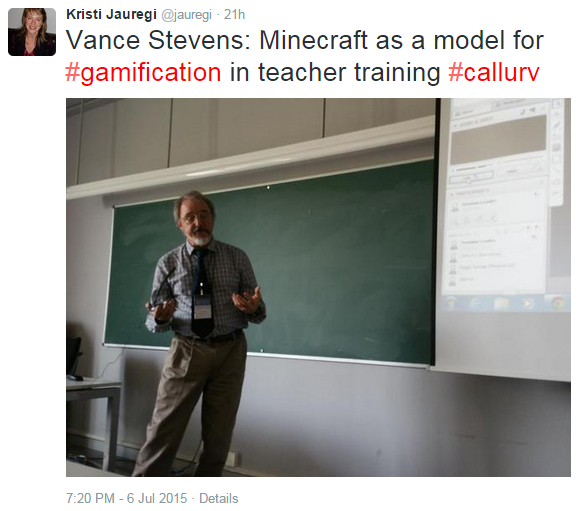
On Monday 6 July there was a Learning2gether session with Vance Stevens giving a presentation at the XVII CALL Research Conference about Minecraft as a model for gamification in teacher professional development
My talk at the conference was entitled Minecraft as a model for gamification in teacher training
There is a short paper about what I will talk about here
In a nutshell, the presentation is about the gamification of professional development, how learning the game of Minecraft (ultimately while trying to stay alive in Minecraft) can inform educators on how professional development can be structured in a more meaningful sense than that which many of us often encounter.
The problem is that the experience is ineffable, which makes it difficult to explain to others who might be amenable to such an approach or who might be appealed to to provide resources to support it. Such drawbacks are overcome in EVO sessions where the small number of participants who choose to join us are predisposed to this kind of learning. However, if I were to suggest to my colleagues at work that we hold future meetings, or even just one meeting, in Minecraft … well the suggestion of meeting in any kind of virtual space goes against the grain of those who like to hear themselves talk in meetings (on the other hand, we used to have great success with departmental retreats at the U of Hawaii, which all were required to attend, leading to similar outcomes but in a more tangible environment).
So I’d like to see if I can pin down some of the affordances or components of such an approach with a mind to making recommendations on how they might be replicated in other contexts
I webcast it via Bb Collaborate / Elluminate, since that is the least problematic way to webcast from a podium. The Blackboard Collaborate (Elluminate) room is at http://webheads.learningtimesevents.org/
On Sunday Jul 5 Vance Stevens and Sabrina Wilson met at Sabrina and Gary’s house in Tarragona, Spain, to talk about how their PLNs converged to make them Globally Connected Educators
Vance was in Tarragona for the CALL Research Conf July 6-8
Sabrina Wilson often attends Learning2gether Hangout events, and she mentioned at a recent one that she lived in Altafulla on the coast of Spain between Barcelona and Tarragona. On Sunday July 5 Vance will be in Spain for the XVII International CALL Research Conference in Tarragona and Sabrina invited my wife and me to stop off at Altafulla for a Hangout on Air about how we have met in various online spaces associated with the Webheads in Action and Becoming a Webhead communities of practice before connecting face to face in Spain.
The discussion will be about whatever comes up, but we’ll be reflecting on the meetings of minds virtually online that often result in face-to-face hookups, and of course reviewing what will transpire the next few days at the XVII International CALL Research Conference in Tarragona, Spain, July 6-8, http://wwwa.fundacio.urv.cat/congressos/call-conference-2015/. All are welcome to join us.
Benjamin Stewart was there and he told us a bit about Microsoft Word Online and how he has been using it with students. He and Vance compared notes on how they have been teaching writing, Vance with voice in Google Docs, and Docs Story Builder for brainstorming.
Sabrina introduced herself in Becoming a Webhead, BAW 2013like this
My name is Sabrina Wilson and I’m an English teacher at an after school academy in Spain. I teach children from 4 years old to teenagers and also adults. I joined the Becoming a Webhead group to learn more about using technology so that I can approach my boss about offering blended learning opportunities to teen and adult students asking for more activities outside of the classroom.
Sabrina, Bobbi, and Vance in Altafulla prepare for the upcoming Hangout
Friday, June 26th – July 1st in Philadelphia, PA 2015 ISTE Unplugged, Each year hundreds of educators interested in social media, technology, teaching, and learning gather to build and participate in “unplugged”-style activities as a part of the ISTE (International Society for Technology in Education) conference. Go to www.isteunplugged.com and read below for details of this year’s events. We’re looking forward to seeing you there!
Thanks to our generous friends at ISTE.org, our NINTH annual set of extra-curricular events at the ISTE conference this year will launch on the Friday before ISTE (June 26th) with an all-day open Maker Day–expect lots of table, activities, and fun for all ages, geared toward education. Saturday’s all-day unconference features special guest Audrey Watters again this year, and huge shout-out to this year’s unconference and evening party sponsor, StudyBlue and Shutterfly. Sunday is our fourth annual Global Education Summit, a three-hour event + connecting party you don’t want to miss. The Bloggers’ Cafe will be open Friday – Wednesday, and we’re really hoping to add an education slam poetry event still. Stay tuned for all events at http://www.ISTEunplugged.com, which also has Facebook event links for each activity.











 My
My

 :
:


























 Learning2gether