On Sunday, February 16, 2020, at 14:00 UTC, Electronic Village Online, http://evosessions.org, held its annual wrap-up and closing ceremony, this time for EVO 2020. The session was run by Carolina Buitrago and Martha Ramirez, our Head Lead and Lead Coordinators for EVO 2020.
In an effort to get everyone to talk to one another, the two lead coordinators conducted a couple of polls and then had the groups go into breakout rooms in Zoom. We found out later that anyone could have recorded a breakout room, but in the main room, the breakouts resulted in silence, so Nellie Deutsch, who was hosting the Zoom sessions, recorded the event in two parts.
The first part displayed interesting display of results from the Polleverywhere (e.g. how the app can form word clouds from data input.
There was then a breakout session. As mentioned earlier, any group in its breakout room could have made a recording of that room. This didn’t occur to anyone, but now we know (for next year, or for our future Zoom sessions)
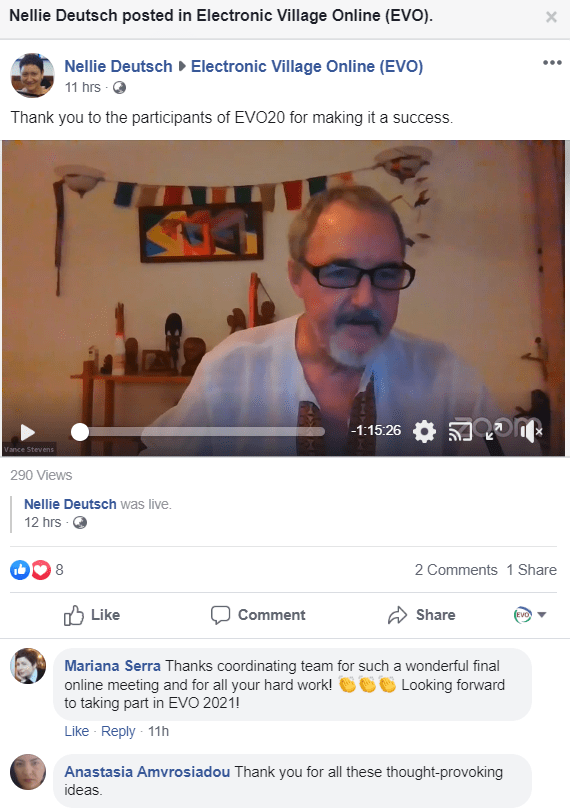
Nellie resumed the recording after the group reconvened. Here is Part 2
.
The sweetest takeaway from this session for me was when Head Lead Coordinator Carolina Buitrago thanked us all for our hard work and passion and said that “It is inspiring to see that there are still people who want to make education better without anything in return.”
The official EVO closing ceremony takes place on Sun Feb 16 1400 UTC in Zoom at https://zoom.us/j/210143084. All are welcome to attend to hear moderators talk about their sessions and to share participant experiences.
EVO Minecraft MOOC can carry on as long as there is a server running and as long as people want to play (and learn, of course :-).
(Co-hosts wee added to our EVOMC20 group announcement for acknowledgement, not actually expected to attend 🙂
And afterwards
Earlier events
Sat Feb 15 1300 UTC Learning2gether 436 Final EVOMC20 Classic 1.12.2 Play and Learn Time – Mattie’s wool race
On Saturday February 15 in the 13:30 UTC time slot organized mainly by Jane Chien, EVO Minecraft MOOC held what was perhaps the final Play and Learn event for EVOMC20 to take place on the “classic” 1.12.2 server for the Electronic Village Online sessions just ended. Jane asked that the session be recorded and Vance and Olivetree (Maha) both complied.
Vance’s recording is here, at https://youtu.be/ati9_FQrU2A
Mattie’s recording of the last half hour, here https://youtu.be/VAxRqI2dego, starts about where Vance’s leaves off 🙂
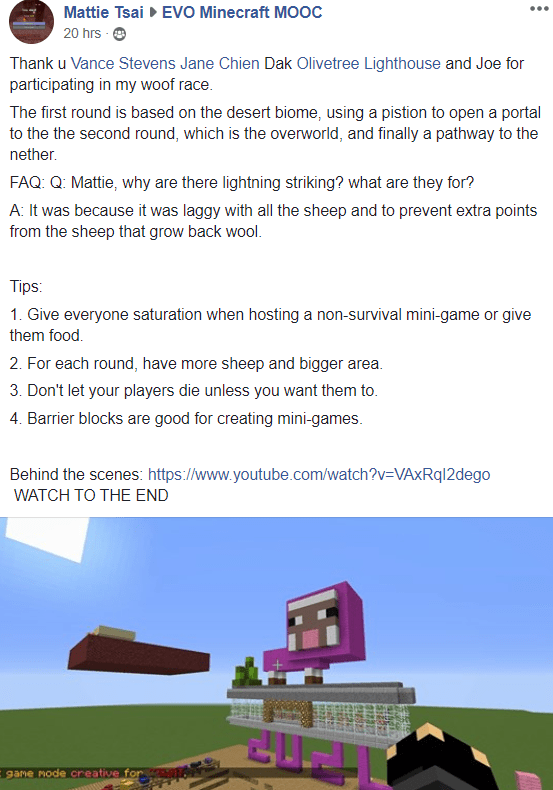
In this event, Mattie (Jane’s precocious young son) had set up a contest in which he had placed sheep in a specially constructed flat map on the classic server. At a signal, participants were to collect wool from the sheep until all the sheep were gone. At the end of that round we moved via a series of portals to other locations where more sheep were kept. At the end of each round of wool gathering lightning would strike and set the sheep alight as well as spread to players if they weren’t careful to avoid the conflagrations. Those scenes were very dramatic :-). At the end of all the rounds, players deposited their wool in boxes set out for them and the wool was counted and multiplied out by the number of points each color was worth to get a total points for each player. We then entered a final warp where there was a special stand erected as if in a sporting event where the winner took the highest position, 2nd place slightly lower, 3rd place, etc. The winners were announced and photos taken of them on the podium. It was all great fun, and a powerful illustration of the powers Mattie had acquired under Magician Dak’s tutelege, which if you asked me (or perhaps his mom), would have contributed to his fluency in English.
Another illustration of his powers came on my arrival in the game where Dak had just died (some think it was suicide) due to a set of armor that had been given him by Mattie. When I arrived Dak’s possessions were still on the ground (players in this version of the game would lose their possessions when they were ‘killed’ in game, and these objects would be on the ground ready for anyone to scoop up). I saw the armor and picked it up and despite warnings from other players not to do so, I put it on. It turned out that Mattie had put a curse on the armor, it could not be removed, and the player would experience strange behavior including death rattles while trying to get rid of it. So that was me, and I managed to record myself going through this experience in the video I recorded. Later when Emmanuel (Rose’s equally precocious son 🙂 arrived, he put on the armor, and experienced the same. I had switched off my recording by then but perhaps Olivetree got it on hers.
It was a nice end to our EVO session, if indeed it was the end. Tomorrow we will be in the official EVO closing ceremony scheduled at 1400 UTC, the hour after we normally meet (at 1300) for the EVOMC20 sessions that Jane has been leading consistently throughout this year’s sessions. Other events that met consistently throughout this year’s event were the ones organized by Olivetree Grove at 1600 UTC almost every day, and those that took place on the 1.14.2 Haliwell server at 19:30 UTC each day put on by Dakotah Redstone and Carol Rainbow.
These aforementioned moderators between them put on at least 50 live events, according to my count at http://missions4evomc.pbworks.com/w/page/134715012/2020_Live_Events, and that list (of 48) does not have all of them. Thanks to them, and to Aaron Schwarz who overcame obstacles to get the server back up and running for us, and others such as Kim Harrison and Beth Ghostraven who hosted us at VSTE, and Abu Fletcher who had to bicycle in the snow to his office in the middle of the night to join us due to the impending and eventually actual destruction of his living quarters (and byzantine delays in getting Internet installed in his current abode, which still hasn’t happened) whew, where did this sentence begin?? and to others as well whom I might have neglected to mention, EVOMC20 can be considered to have been a great success!
At the event last night, there was some talk of finding a common platform for next year. This past year we were divided into silos where some of us followed the proceedings at Groups.io and others adhered to Facebook. We discussed carrying forward with the Moodle provided to us by Nellie Deutsch, which she has kindly provided us but which we didn’t activate for this year, and looking into Schoology, which Teacher Vance is using for some online workshops he’s giving over the next three weeks. Talk of a 7th year of EVOMC(21) is always encouraging, a sign that what we have spawned over the past 6 years has transformed into a true community of prractice.
Thanks to all our fine moderators past and present who contributed in many small and in many very large ways as well to this grand endeavor.
Details of the event tonight (or afternoon or morning, depending on where you are on the planet)
When: Saturday, 15 February 2020, 1:00pm to 2:00pm, (GMT+00:00) UTC Where: EVO Minecraft and Discord Servers
Organizer: Jane Chien and Vance Stevens Description: Yes, we’ve reached the last week of EVOmc and it’s time to reflect. However the playing and the learning continues. Join us to continue exploring, building, trading and learning. If you have questions, ideas, suggestions bring them all with you.
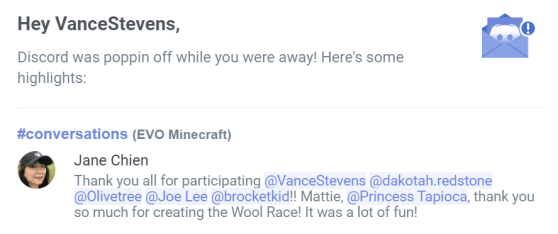
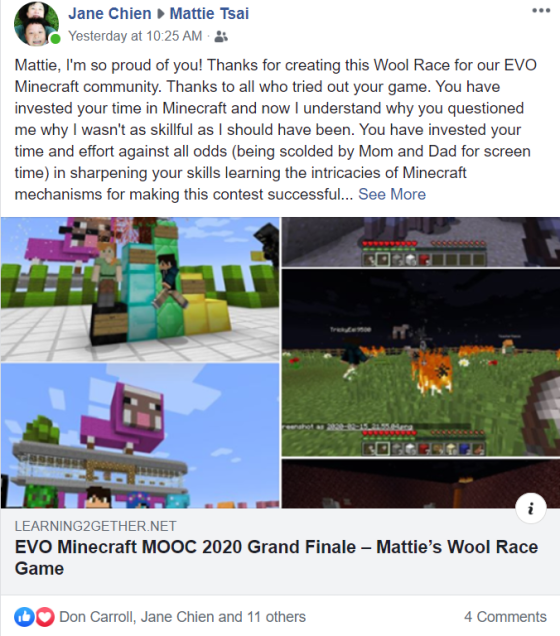
Thanks for participating in the wool race that Mattie built. There were three rounds of wool sheering with a point system assigned to the different colors of wool, one point for white wool and 10 points for color/Jeb wool. We were all going for the Jeb sheep but Olivetree was the lucky person who found all the Jeb sheep, one for each round.
The first round was in a desert. Then a portal opened where we were dropped to the second round, which is the overworld. We were bounced off to a field of green slime blocks with grass growing on it. When we sheered off all the wool from the sheep, strikes of lightning were aiming towards the sheep and we had to avoid being struck by lightning. (Mattie, why the lightning?)
Unluckily, Vance was struck when we were ready for the third round, which was the Nether. Oh, no! He lost his sheers after he respawned. I immediately gave him my spare ones.
There were so many sheep in the Nether round that I got so excited until I found out there was another round of lightning and we had to stay away from the sheep in order not to be struck by lightning. Olive shouted: “But I’m away from the sheep!!!! I was standing away from the sheep when I got struck!” Dak explained that there was an area of effect so we needed to stay far away from the sheep. I was so happy that in the end, we all survived the last round!!!
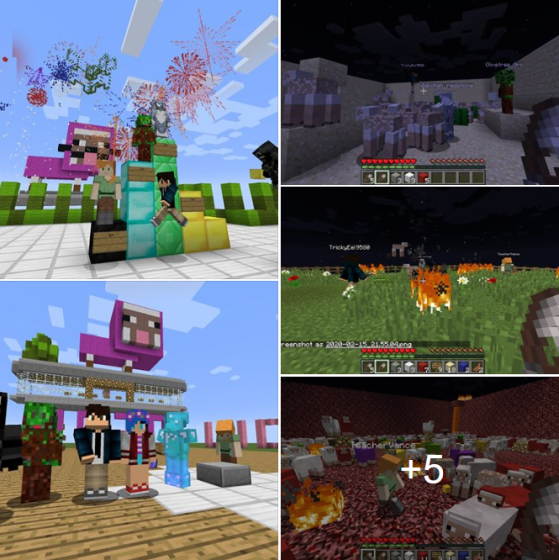
After calculating the points, the winners were teleported to the winner’s podiums and there were fireworks in the background to celebrate their wins!!! Congratulations, Dak, for winning the first place, Olive for winning second, Joe for winning the third place, and Vance the fourth place. I only got 164 points so I was there with Emanual to take pictures and congratulate them! Hurray!!
Here is the thumbnail view from Jane’s Facebook post after the event, from which the above text is taken
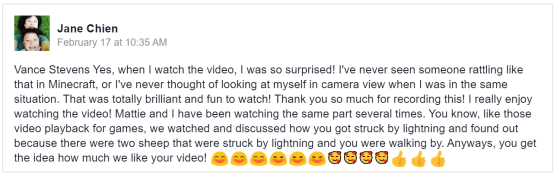
and one more thing, Vance Stevens posted on FB that Jane couldn’t help but tell her breakout group in the EVO annual live wrapup event for 2020 about Mattie Tsai‘s accomplishments, and when the participants reconvened Mike Kenteris relayed that information to the whole group, and on YouTube, as you can see here,
Jane ChienThank you so much, Vance!!! Thanks for giving Mattie the opportunity to learn to host this game. He still has so much to learn and thank you for this wonderful experience! I really enjoy watching your video and Mattie’s as well! I did not know Mattie could record the game.
Jane ChienAaron Schwartz Thank you so much for hosting the classic server! We wouldn’t have had such great fun learning together without having the variety of options to in-game play, the fun plugins like GodMode and all! Thank you! Thank you! Thank you!!
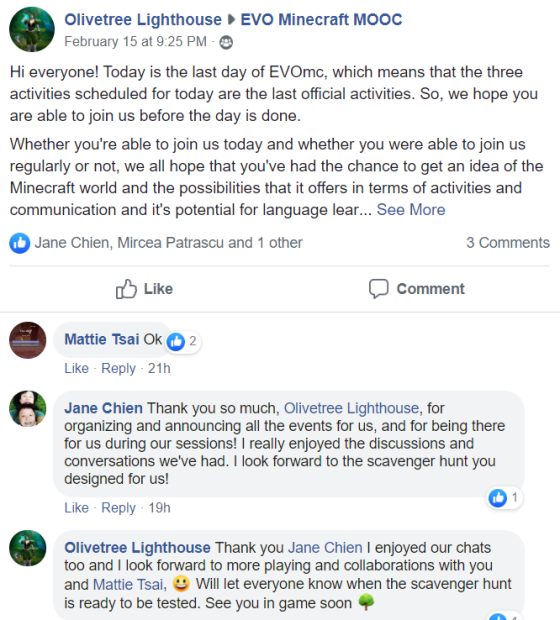
Olivetree’s post continues, after language learning …
Also, the learning doesn’t stop. When you want to learn something new, if you need help, or you just want to play and experiment while having a chat, just drop us a line on Discord letting us know when you’d like to meet. We will also announce whenever we have community play time. Lastly, you are most welcome to drop in and play on either of the servers, EVO and Haliwell anytime you feel like it.
Nice wrapup 🙂
Earlier events
Sun Feb 9 0420-0450 UTC – LEARNING2GETHER 435 – Vance Stevens on Teaching English through practical projects in coding
Mon Feb 10 CodeVA Computer Science Educator of the Year at VSTE Space in SL
CodeVA Computer Science Educator of the Year at VSTE Space
Monday, February 10th, at 5 PM SLT, come hear Willoughby Lorefield (Fara Faust in RL) share information about about CodeVA and their mission to bring computer science to every student in Virginia. She will also share teacher education opportunities offered through CodeVA.
If you don’t have a Second Life account get one, it’s free. We recommend setting one up at the Rockcliffe University Consortium’s Gateway here:https://urockcliffe.com/reg/second-life/ Download and install the software. While your Second Life viewer (software) is open click this linkhttp://maps.secondlife.com/secondlife/Soulgiver/155/144/58 and voila! Look for an avatar on VSTE Island and say, “Hey, I’m new!” We will take care of the rest.
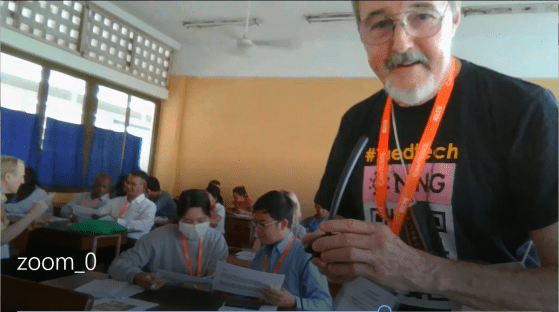
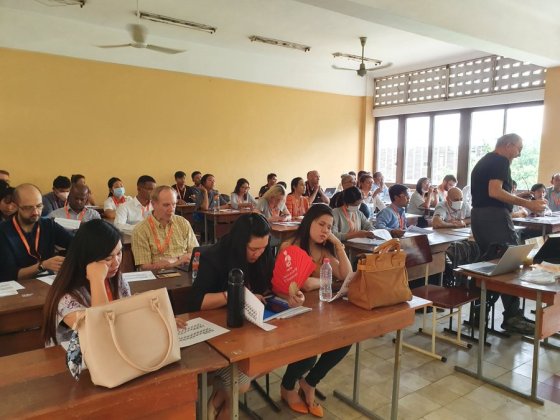
I attended the CamTESOL 2020 Conference in Phnom Penh from Friday, February 7 to Sunday February 9. My proposal for a workshop was accepted and scheduled to be delivered on Sunday Feb 9, 11:20-11:30. The title of the workshop was
Teaching English through coding using collaborative projects that don’t require specialist skills or even a computer
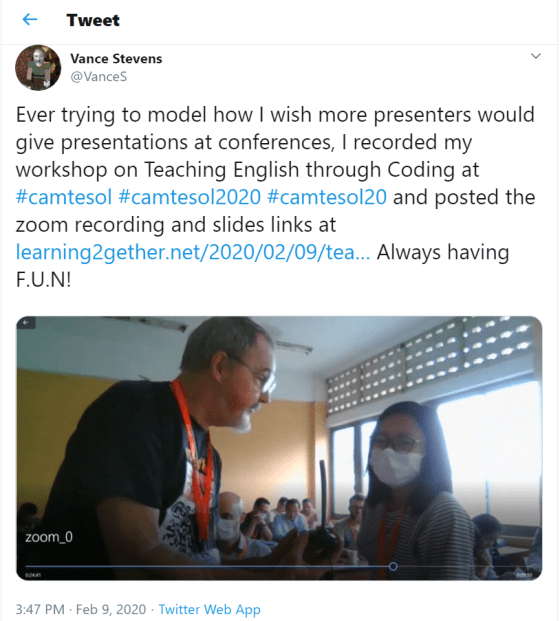
The workshop was recorded in Zoom
Abstract
The workshop sought to show how language skills can be developed when the focus of a lesson is not necessarily on the language itself but more on tasks involving using English communicatively and thoughtfully. Many students and teachers realize that some knowledge of coding is an essential skill in the modern workplace, and are therefore receptive to learning more about it. The presenter gives examples of language teachers who use coding in language classes to promote the 21st century skills of critical and creative thinking, analysis, and problem solving, in addition to the more obviously language-related skills of communication and collaboration.
The workshop introduced and guided participants through a simple activity using a step-by-step approach, presented in accessible terminology, that would clarify for them this relationship between coding and language development. The activity is set out in a handout that participants can use during the workshop and with students later in class. The activity requires neither a computer nor prior knowledge of programming, only the instructions on the handout, and participants were pointed to repositories of many more such activities.
The link above was created for a longer, 45 minute, similar workshop at ThaiTESOL on January 31, 2020
The same proposal was accepted for presentation at CamTESOL on February 9, 2020, but only as a 25 minute “workshop” with 5 min allocated for questions.
This was too short a time to get participants engaged in doing much of anything beyond grasping the concept, but it was ample time to deliver the presentation as a webinar and leave a recording that participants can review later,
so I made plans to webcast it as Learning2gether episode 435, indexed at archiveindex
Where? In Zoom
Topic: Vance Stevens on Teaching English Through Coding
Time: Feb 9, 2020 04:00 AM Universal Time UTC
This was my plan of delivery
A tea break preceeded my presentation so I was able to go into the room half an hour beforehand and get set up before I needed to actually get started at 11:20 in Cambodia
I tried to explain the topic briefly and show the audience that a prior lesson could have been on sorting algorithms.
I got the face to face audience to play the battleship game and discuss its benefits for teaching English.
I had to stop the presentation at 4:50 UTC (11:50 in Cambodia)
I invited distant participants to join us (but no one did) When? 04:20 to 04:50 UTC on Feb 9, 2020
Fri 31 Jan 0915 UTC – Workshop at Thai TESOL by Vance Stevens on Teaching English through coding without a computer
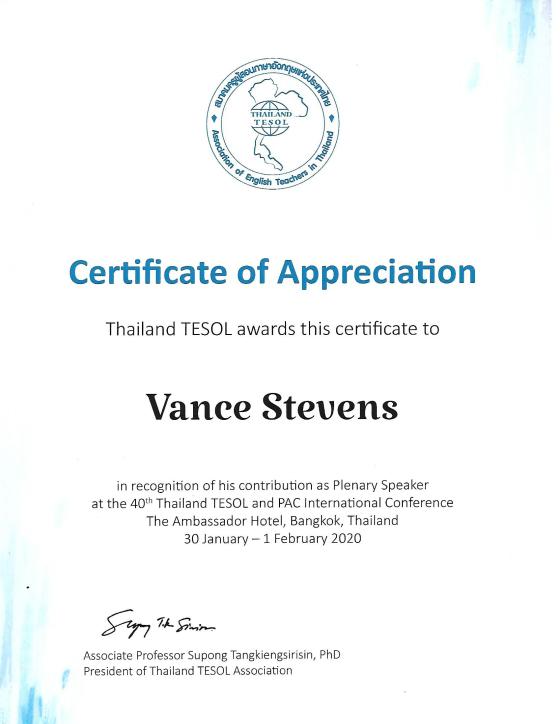
I have been invited to give a demonstration and workshop of 45 minutes including discussion, at the 40th Thailand TESOL-PAC International Conference at the Ambassador Hotel, Bangkok, Thailand on the topic of: Teaching English through coding using collaborative projects that don’t require specialist skills or even a computer, on DAY 2: Friday, 31 January 2020 16:15-17:00 in Thailand
Artificial Intelligence (AI), Blockchain & Augmented Reality Digital Technologies (ARDT)
Thoughts on Language Acquisition for the 21st Century
Prof. Jasmin B. Cowin, Ed.D.
Gen Z and Gen Alpha continue to drive Augmented Reality Digital Technologies (ARDT) expansion into all industries from corporate environments, marketing to healthcare, and gaming to language education. Location independent, virtual environments hold the promise of exponential expansion beyond the brick-and-mortar presence of schools, colleges, universities and other institutions of learning such as Virtual Schools and Universities. These learning centers are being transformed by intelligent systems that help humans learn better and achieve their learning objectives. The breadth of areas in which AI is already inserted in education includes intelligent tutors or chatbots, personalized learning, smart teaching, learning analytics, reducing student drop-off, education administration, data privacy and ethics. The Blockchain offers new ways of storing, tracking and verifying students’ credentials. This 30 min. webinar presentation will explore these concepts in education, and looks at what the future might mean for language professionals, students and institutions in the 21st Century.
Using Wikis to Develop Learners’ Critical Literacy Skills
Lesley Painter-Farrell
Abstract:
Developing critical literacy skills means arming learners with a variety of skills, which allow them to decode texts, understand text bias and draw on cultural clues to process and synthesize information. Ultimately, learners become empowered information managers (Shapiro and Hughes, 1996), which in this age of clickbait and fake news has never been more important. In this webinar, the presenter aims to illustrate how wikis can be used in and outside the classroom to effectively practice and develop learners’ critical literacy skills and how this application is conducive to detailed and directed text interrogation.Ttwitter
This plenary address was delivered live face-to-face at the ThaiTESOL conference in Bangkok, Thailand, and simulcast by Jeff Magoto as a live webinar recorded in Zoom for the benefit of the EVO Flipped Learning session – here: https://youtu.be/FXEhAHul0bU?t=662
The plenary was preceded by 2-weeks of English Language Specialist workshops in Thailand, which can be seen online now at http://workshops2020.pbworks.com/. The link was given out prior to the workshops to institutes where the participants were, which does not mean the links always reached the participants in advance, but this would have made it possible for the workshops to be flipped so that background information would have been previewed by participants, who would then focus primarily on the activities in the workshops themselves. Then after the workshops, all participants still had an archive of what they did at the same link.
Following the workshops I gave the plenary at ThaiTESOL on Flipped Learning and Jeff Magoto streamed it directly to the Flipped Learning EVO session as one of their weekly webinars. My plenary took place right after lunch, so I went to the auditorium ahead of time and got set up there and connected in Zoom with the Flipped Learning Webinar, so that the webinar was in session and on the big screen, audio issues more or less resolved, when the plenary audience arrived.
The 2020 EVO Flipped Learning session figured prominently in my plenary address. For their part, for sharing my plenary with them, they sent me a certificate of participation in their session.
This video explains what I had planned here in its wider context
These are for an English Language Specialist Project: Workshops in Thailand January 2020
At http://workshops2020.pbworks.com/ find the HOME portal for a series of workshops conducted by English Language Specialist Vance Stevens at various universities and language centers in Thailand to English lecturers and undergraduate and graduate university English majors on using CALL (computer-assisted language learning) and technology for blended classrooms. The workshops model how teachers can create blended learning environments using free Web 2.0 tools and websites.
These workshops encourage and train teachers to learn best practices from peer models, in order to in turn model for their students how technology can best be utilized and applied appropriately in their students’ learning.
There are two workshops in 4 and 2 modules respectively. The modules are designed to be delivered in the amount of time allocated to those workshops at each presentation location in Thailand. Details can be found at http://workshops2020.pbworks.com/
Earlier events
Sat 11 Jan EVO Minecraft MOOC kicked off its 6th season in Discord and Minecraft
To talk to others live online is the best and sometimes cheapest way of practicing a language in real-time with via internet. Virtual environments offer opportunities to meet speakers of other languages and native speakers alike but there are many 3D spaces out there and sometimes it is difficult to decide which one to join. Which virtual world is suitable for language education?What kind of equipment or software do you need? How long does it take to get to know this world before we introduce this to our students? Is this virtual space safe for our learners? Come join to find out. For a period of 5 weeks we meet online twice or three times a week to explore some 12 different virtual 3D environments and look at how these could be used for language teaching and learning. An EVO session is a free online workshop aimed at professional languageeducators with teaching experience, language consultants, language schools or publishers.Everyone can attend even without a fast computer and you do not need an HMD headset nor any special technical skills. We will meet in a video conferencing solution called Zoom and will use screensharing to showcase. We hope our participants join us actively in trying to evaluate these environments to come up with our top 5 virtual spaces suitable for language learning. For more information see http://vlanguages.pbworks.com and we look forward to you signing up using this Google form https://forms.gle/DDtKoB8TiVPsuFUr8
Jan 21 Vanessa Paz Dennen and JiYae Bong describe research on participants a MOOC that focused on social media use
The URL below is the recorded conversation undertaken on Tuesday, Jan. 21, 2020. Vanessa Paz Dennen and JiYae Bong from Florida State University describe their research on the dialogues and the engagement patterns of an international group of participants a MOOC that focused on social media use. Although their perspective is that of instructional designers and researchers, their insights may be of use to the TESOL audience interested in the online medium as a medium of instruction. As with all ongoing research, the speakers demonstrate constant problematization at several levels including at the theoretical level (Hofstede’s Cultural Dimensions theory) and in the appropropriateness and adequacy of the conceptual categorizations of “national,” organizational and tool cultures. Pedagogical implications are discussed with the caveat that there is much that remains unknown and to be explored.
Paper: Dennen, V. P. & Bong, J. (2018). Cross-cultural dialogues in an open online course: Navigating national and organizational cultural differences. TechTrends, 62, 383–392. doi.org/10.1007/s11528-018-0276-7
EVO Minecraft MOOC kicked off its 6th consecutive season as an Electronic Village Online session on the first day of EVO 2020, Saturday, January 11, 2020. We dubbed this a “final preparation” to be held in Discord and Minecraft, but besides many of this year’s moderators (and their kids), we had several newcomers turn up. It was encouraging to have several new participants appear on the very first day of our activities.
In this, our first adventure of the 2020 season, we showed our newcomers some of the resources around the spawn point and stepped through the wilderness portal there to arrive at our wilderness outpost. From there we followed a path and crossed a river to reach the nearby village, and headed for a tower due west of there. Continuing west along the river we arrived at a second tower built atop a shelter, from which we set off to neutralize a nest of skeletons emanaing from the spawner that Teacher Vance had discovered earlier in explorations around the wilderness portal. When it was working, the spawner was a great source for bows and arrows.
On the first day of EVO20, and 24 hours before the official EVO kickoff event Jan 12 we attracted several moderators and a few newcomers to Minecraft.
If you can’t reach those spaces, drop by Vance’s Zoom Learning2gether Zoom Learning Space https://zoom.us/j/5786977523
Heike joined Vance briefly in Zoom (pictured below) but I left that space after half an hour in order to focus on the others on the EVO Minecraft server and speaking in DIscord
When? The event was set for Sat 11 Jan at 1400 UTC
We gathered at the /warp Whitetower (or /warp spawn) and then went over to the /warp hub
From there we stepped into the Wilderness portal and were beamed up to the wilderness outpost
There is a high point there with a ladder up a tower where you can then jump into the treetops and get a nice view
From there we took a trail signposted “to the village” and crossed the river to the village with a red building added by Dak
Heike had had a run in with a skeleton by then
From the red building you can see a tower to the west
From that tower you head for another tower in a bend in the river at the base of the mountains
Here are the coordinates for the second shelter
From there, going down to the bend in the river, you find your way signposted up the mountain. Follow the torches.
Up the mountain we found the spawner guarded by skeletons
Lots of skeletons (they just kept coming). There was a grand battle
Most of us survived, barely
Hi mom, it’s meeeee !!
You can suppress the spawner by putting torches on it. Mobs don’t spawn in bright light.
Dak built a wall around the spawner designed so that skeletons coming out of the spawner wouldn’t be able to shoot out but someone outside could shoot in.
In preparation for EVOMC20 in early January
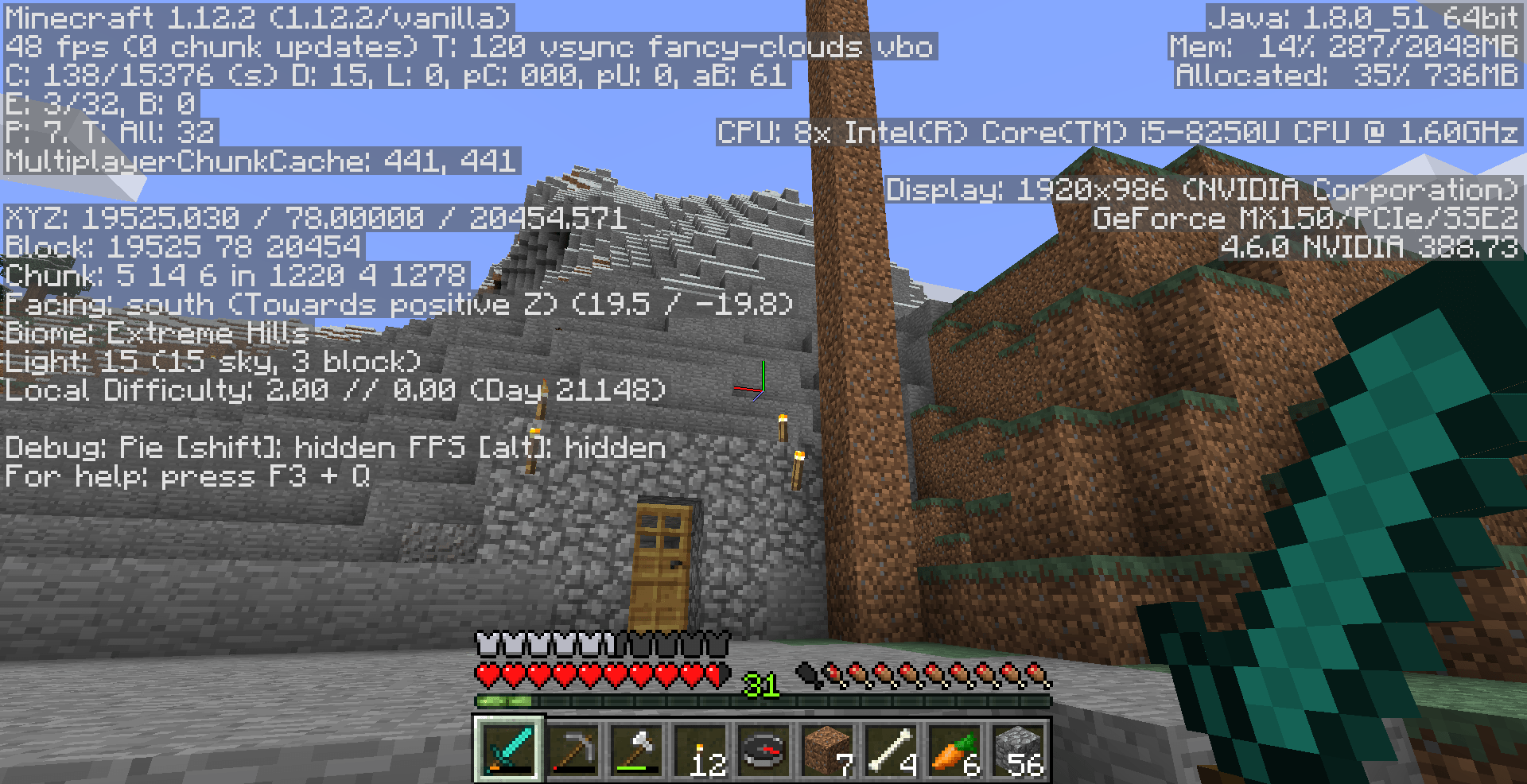
Teacher Vance and Bobbi Bear and Jane Chien and Olivetree Grove and others have been exploring the area northwest of the Wilderness Warp at 20k x 20k on our classic server. Those are the X (-west +east) and Z (-north +south) coordinates you see when you press F3 in Minecraft.
Our new area is in the tiaga at around 19.5000-X and 20.5000-Z Here are some screenshots of the area:
You can tame llamas nearby if you give them about ten bundles of wheat
If you feed parrots seeds they might sit on your shoulder
Be careful, some of the candlelit paths up the mountains come out on a skeleton spawner
woops!
You can recover wherever you respawn. Right click on a bed inside this shelter to set a bed spawn here.
Here are the coordinates for this shelter
Down across from the bend in the river you find your way signposted up the mountain
You can see some of the torches marking the way up behind AbuFletcher. The spawner is a good place to pick up a few arrows, and you might collect some bows if you manage to get a few skeletons before they get you. If you linger there they’ll overwhelm you.
There are ways to deal with spawners. The first step is to light up the chamber. We’ve put enough light there where we can see our way in the dark cave, but we’re leaving this for a group of EVOMC20 adventurers to sort out. Welcome to join us.
Earlier events
Wed 11 Dec 1500 and 1900 UTC -Macmillan hosts Deborah Healey on Gamification in ELT
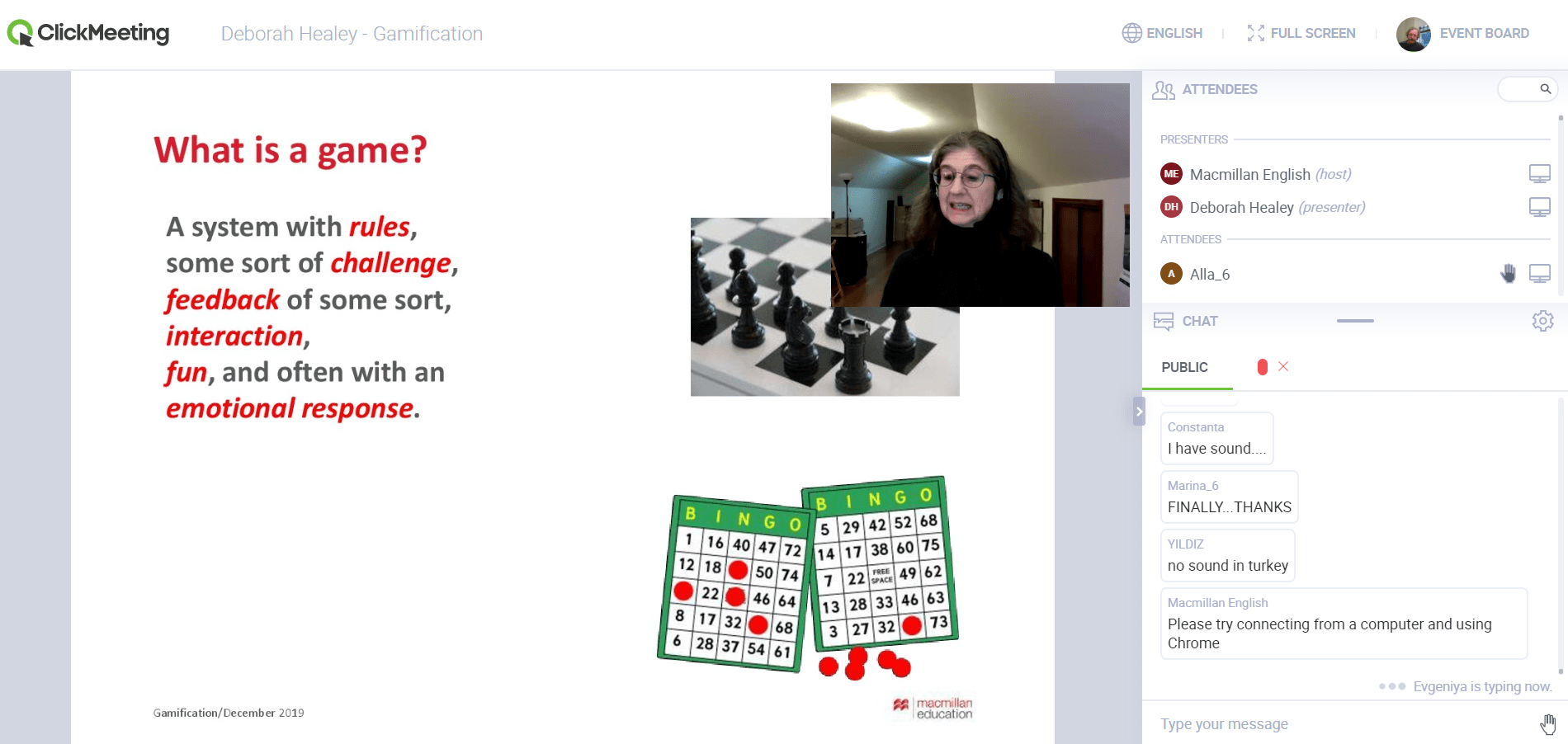
On Wednesday December 11, 2019, Macmillan Education hosted Deborah Healey speaking in a pair of free webinars on Gamification in ELT. These were presumably the same webinar held at two different times in order to span time zones and widen the audience. Learning2gether.net attended this event but played no role in its organization.
“Games have long been part of language teaching methods. Gamification is something else, and teachers can benefit from learning about the elements of games that may be effective in connecting to today’s learners. Very importantly, teachers can develop a way of thinking about teaching and learning that takes a gaming approach and changes potentially passive “students” into active “players” in the classroom environment. As with anything else in education, it’s how the techniques are used that makes a difference. This webinar will give a brief introduction to gamification with some insights from research, and present how teachers might use game elements effectively in their teaching. Suggestions for technology supports will also be offered. A website will provide links to additional resources and specific examples that teachers can use in their own classrooms.”
That document gives links to 14 useful reference and resource material items and lists the following Key Concepts of gamification (the 5 key concepts and final comment below are all quoted from that document)
Key concepts
Gamification isn’t about using games; it’s about adding game elements to ordinary classroom activities to create a novel feeling and achieve goals, such as enhanced motivation and engagement
Teachers already use some game elements. Now we need to add “game thinking” and “players”
Counting up is more motivating for most learners than counting down (deducting from an initial A+)
Project-based learning fits very well with gamification: quests, epic challenge, team work
Gamification has to be done well to work. Too much focus on extrinsic rewards can reduce intrinsic motivation
Final comment: The teacher’s role is to establish the learning environment that is motivating, engaging, and linguistically rich. The teacher needs to build intrinsic motivation, not just extrinsic with points and badges. When learning is motivating, that’s intrinsic motivation. It’s where we want our learners to be. – Dr. Deborah Healey
Here we find three additional resource documents. The first one, #3, Healey Gamification Resources A4.pdf, is the one that we were looking at that contained the tiny URL. Here is what else you can find and download from that folder:
Pasting from that link, we find a depth of background information on the topic:
Overview
Gamification is becoming an increasingly popular concept in teaching. Today’s “digital residents” have grown up with video and computer games, and they look for excitement. The fast pace of many games fits their short attention spans. The concept of “gamification” – using game elements in non-game contexts to motivate and persuade – is moving from marketing to teaching. While games have long been part of a language teacher’s bag of tricks, teachers can benefit from learning about the elements of games that will help us appeal to today’s learners.
The page on Game Mechanics offers a description of several of the game mechanics that could be used in the classroom, while the Games and Gamified Activities page points out ways that game mechanics can be added to specific classroom actions.
The Resources page provides references and links to additional reading, including a download of my brief article on the difference between gamification and game-based learning.
Tue 03 Dec 0100 am UTC VSTE Minecraft Monday – Holiday Pixel Art
The day above should be Tue (Monday in Maine) but if I change it now it will break the link. The timeanddate link below is correct
The Minecraft Monday event for Monday, December 2nd 8-9 PM Eastern time is Holiday Pixel Art
Let’s make VSTE Place festive for the season!
Meet at VSTE Place Minecraft world, and create holiday or winter pixel art.
Find a design online or create your own on graph paper before the meeting. This is much easier than cross stitch!
If you can share your pattern with a friend, you might get help with your creation!
Basic directions to join VSTE Place, VSTE’s Minecraft world
You must have a computer Minecraft account from https://minecraft.net/en/ to join. There is a one time fee of $26.95.
Download and install the software.
Choose multiplayer and add a server: Name VSTE Place IP 69.175.17.26:25565
Our server is protected. You will need to be whitelisted to enter.
Email Kim Harrison at K4sons@gmail.com from an educational email address with your real name and Minecraft account name.
VOIP in Discord
Discord is a voice and screen sharing application that will run on your computer or mobile device.
Tue 03 Dec 1600 UTC – Online Students – Who they are? What they look for? What is online learning satisfaction?
TESOL’s Teacher Educator Interest Section (TEIS) is continuing its live webinar series. We begin the series this season on students in online education.
Credentialled TESOL members can download a ppt associated with this presentation here (but I presume the webinar, in Zoom, is free)
A recent Babson Survey Research Group reports that about 33 percent of college students are taking at least one course online. More than 2500 U.S. colleges and universities are offering courses online and Indiana University (IU) is one of them. It has seen a significant upswing in enrollment (130%) between 2013 and 2019. The IU EFL/ESL teaching certificate program has seen a similar spike.
Given the high interest in online education and the increasing number of TESOL online programs, TESOL’s Teacher Educator Interest Section (TEIS) is organizing a webinar on who are the online students, what they are looking for and what gives the students the most satisfaction?
The webinar features as speakers, IU Associate Vice-President and Director of the Office of Online Education, Chris Foley and Associate Director, Sharon Wavle. The webinar will be moderated by Faridah Pawan, TEIS Chair Elect, Professor of EFL/ESL Teacher Education at Indiana University
The details are as follows:
Date and Time: December 3, from 11-12pm EST (same time as New York City)
In the recorded TEIS webinar below that took place on Tuesday, Dec. 3, IU Associate Vice-President and Director of the Office of Online Education, Chris Foley and Associate Director, Sharon Wavle discussed and shared information on who online students are; what they look for; and what online learning satisfaction is for them. The webinar was moderated by Faridah Pawan, Professor of EFL/ESL Teacher Education and TEIS Chair Elect.
Coming next: In January 2020, the second webinar in the series will feature Venessa Dennen & Jiyae Bong from Florida State University on Cross-Cultural Dialogues and Cultural Differences in Online Conversations.
I was first alerted to this event when Philip Shigeo Brown posted this reminder on Facebook just the day before:
International Teacher Development Institute (iTDi) MonthlyRoundup (FB LIVE) with Philip Shigeo Brown & Steven Herder: Fri Nov 29, 1200-1300 GMT: https://www.facebook.com/iTDi.Pro/
The graphic was interesting 🙂 so I decided to drop in. I had intended only to see how this event worked. I hadn’t had enough notice to make it a Learning2gether episode in its own right, and I didn’t know I would be called on to participate. When I arrived, Steve was explaining how he had prevailed on the powers-that-be at the most recent 2019 JALT conference to stream their most recent plenaries and put the recordings on open access:
At first I was only listening to Phil and Steve on my PC talking in Zoom while broadcasting that through Facebook, so I got the event up on my iPad and took it into the kitchen to do the dishes. But when I heard them talking about my interview with them the previous week, I dried my hands and made a screen shot. You see? I was starting to get engaged.
And then when Steve invited anyone listening in Facebook to come into the Zoom room and join the conversation, Andy Boon and I obliged, joined later by Barbara Hoskins Sakamoto.
Steven called our attention to Gianfranco Conti’s website Error Correction: The Language Gym, https://gianfrancoconti.com/category/error-correction/. Dr. Conti is a prolific author who asks, “is the time and effort [spent] marking justified?” Dr. Conti draws on “thirty years of error-correction research, my personal experience as a learner of 14 languages and teacher of five and, more importantly, neuroscience and common sense [to] suggest alternative remedial approaches to MFL learner errors which are as or even more effective than the trending methodologies.” https://gianfrancoconti.com/2017/02/04/why-marking-your-students-books-should-be-the-least-of-your-priorities/
Vance contributed a technique for using voice to encourage revision from student writing begun on paper. The technique has the students share a Google Doc with him but start their writing on paper in class. The teacher collects the papers and then reads them correctly into Google Docs using speech-to-text. The teacher makes printouts of what the students wrote expressed in correct language and writes on these printouts suggestions for revision and improvement of the papers. The paper printouts are returned to the students along with their original papers, and the students continue writing in Google Docs, for as many revisions as possible, now focused on whatever errors occur or re-occur. Vance has presented this technique on numerous occasions, and the link shared in the chat is one which also has links to a writeup about the technique, as well as to its slide presentation https://learning2gether.net/2019/08/04/learning2gether-with-vance-stevens-at-mmvc19-supporting-student-writing-with-the-help-of-voice-to-text/
Vance also contributed the link to a screencast he recorded while in his office giving feedback to a student elsewhere on campus on the student’s writing, using Google Docs. The video illustrates the effectiveness of the technique: https://youtu.be/bH1p86lXD40
Vance argued that papers covered with red ink were useful only if there was some evidence of follow-up by the student; for example, if errors detected on one round of correction were tracked into the next round to see if they recurred, and if they did, that they be addressed at another remedial level. Here, Steven referred me to the work of Dana Ferris, which Vance Googled to turn up her book, Treatment of Error in Second Language Student Writing, a “principled approach to the theory and practice of error treatment that can guide pedagogical decision-making.” https://books.google.com.my/books/about/Treatment_of_Error_in_Second_Language_St.html?id=SxFaAAAAMAAJ&redir_esc=y
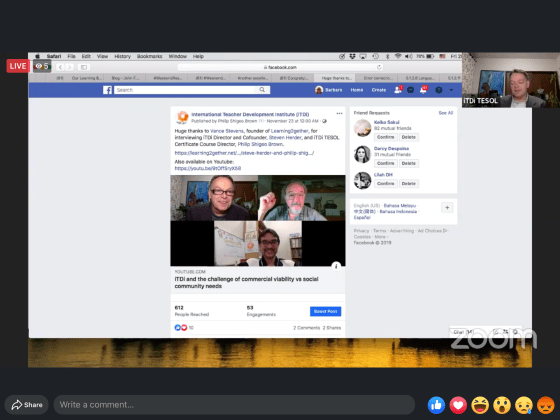
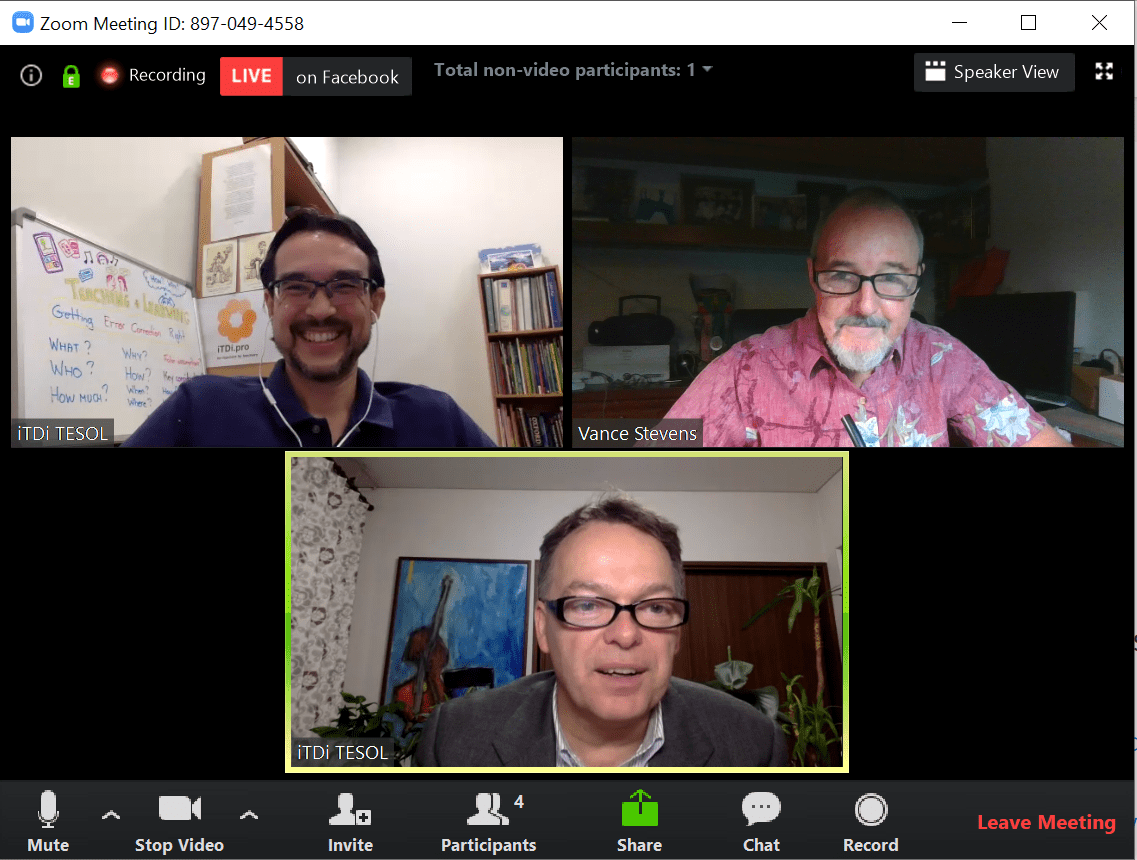
On Thursday. November 21, Steve Herder and Philip Shigeo Brown talked to Vance Stevens about iTDi and the challenge of commercial viability vs social community needs
Vance Stevens, founder of Learning2gether, talked with iTDi Director and Cofounder, Steven Herder, together with TESOL Certificate Course Director, Philip Shigeo Brown about iTDi, how it came about: when it began to be planned in 2010, then launched in 2012, and why, what it does, where it’s going, and how it serves the field of language learning.
In particular, how does iTDi balance the needs of the #iTDiCommunity with the need to remain commercially viable? In the context of that challenge, what kind of teacher development opportunities are offered and should be offered in the future?
Learning2gether promotes efforts that share knowledge in a free and open manner (share-alike in creative commons terms). As founder and coordinator of L2g, Vance is both interested in and impressed by the aspects of iTDi that do that. Whereas L2g does not promote commercial interests, I have no qualms whatsoever about spotlighting the altruistic work of for-profit entities that help to spread knowledge in our wider communities.
I gather from talking with Steven and Phil in the past that they seem to embrace that mindset while at the same time they and others at iTDi are seeking a fair return on the parts of their work where their professionalism shows devotion of time, expertise, and investment.
Achieving a return on investment is only right and fair, but I’d like to discuss how iTDi straddles the challenge of providing a service to the field while at the same time being compensated for it, and recruiting others to their team in return for their just compensation as well. In discussing these issues, I hope to find out more about how iTDi manages these challenges, and of course where they see it going. – Vance
These questions were alluded to during the conversation
Regarding this balance of service to the community vis a vis iTDi’s right to support itself and its investors (of time, money,expertise) I believe these questions were touched on in the discussion.
The iTDi website says that attendees are welcome to attend the Teachers Room sessions for a particular amount of time.before they are expected to subscribe. For this reason, I don’t announce them on L2g. When I have been there it seems you have welcomed participants. How does that work in practice?
We talked about JALT and IATEFL streaming sessions, in other words providing free content while making money elsewhere on the paid event (presumably). Does iTDi have a parallel model?
What can people do or participate in for free as community members vs what they must pay for, given of course that the paid areas would be ones where they could gain certification perhaps? Do you know W3 Schools? All their materials are free (choose from dozens of programming languages and help yourself) but if you want to be certified, you pay for that. (In the conversation, we found that iTDi had experimented with something similar).
What does iTDI do to develop their community. What benefits are there to community participation? How would users increase those benefits by upgading to paid services?
I presume you are teachers like me with a passion for sharing and contributing to the field, but are hoping to monetize the process to some extent for yourselves and others for reasons similar to why people don’t write books for free? What makes this tick?
All of these issues were touched on in the recorded materials. Have a listen!
On Wednesday, November 20, 2019, Hanaa Khamis and Vance Stevens presented online in Blackboard Collaborate at the annual Global Education Conference, (GEC). The title of the session was
Highlighting the participatory culture of continuous professional development through self-sustaining professional learning networks
Hanaa Khamis, NileTESOL PD Committee Chair and Learning Technologies Special Interest Group (LTSIG) Co-coordinator The American University in Cairo/School of Continuing Education (SCE/AUC)
Vance Stevens, coordinator of EVO (Electronic Village Online) and founder/coordinator of Learning2gether.net; Twitter (@name): @vances
Short Session Description:
This session aims at highlighting the benefits of experiencing participatory cultures in continuous professional development (CPD) among ELT practitioners by raising their awareness of the potentials inherent in working through personal learning networks (PLNs).
Target Audience: ELT educators, program leaders, teacher trainers
In this session, the presenters will share their experiences in creating several communities of practice which have crossed paths online and face to face. These communities have aimed to spread the culture of continuous professional development (CPD) among novice and more experienced ELT practitioners locally and globally.
ELT practitioners can miss out on CPD for all sorts of reasons. One assumption is why does one need training when one has received recognized certification in teaching? Another is, with all the burdens of teaching, why overload oneself with extra hours of needless CPD? A third is that it is such a luxury to consider training with the low pay teachers get. A fourth is how can one connect with those who provide free training opportunities?
The presenters have identified these and other issues that prevent ELT practitioners from benefiting from numerous training opportunities of which they are oftentimes not aware. As part of their passion, the presenters spend time and make relentless efforts to reach out and help practitioners join networks of various shapes and forms.
Professional development in TESOL is not a one-time event in the career of ELT practitioners. As much as we ask our learners to be lifelong learners, the least we can do is be role models. CPD is a culture of its own requiring dedicated and passionate teachers. It is a reciprocal process of give-and-take; one time you are a participant, another time a trainer, and the cycle goes on.
Participants in this session will recognize the fundamentals of maintaining a CPD participatory culture. They will identify various ways to collaborate and create within the framework of personal learning networks (PLNs). Finally, they will suggest CPD principles appropriate for their contexts.
Other Websites / URLs Associated with Your Session:
Vance Stevens lives in Penang, Malaysia. He has produced (up to now) 429 episodes since 2010 of Learning2gether.net. His over 150 publications, many available at http://vancestevens.com/papers/, deal with students using computers to learn languages and teachers learning to teach using technology by engaging in communities of practice and in participatory cultures. His accomplishments earned him the 2019 CALL Research Conference Lifetime Achievement Award.
Hanaa Khamis is an instructional technologist at the American University in Cairo (AUC). She is also an English language instructor and teacher trainer in the School of Continuing Education at AUC. Her research interests include cross-cultural communication, communities of practice, instructional technology, network-based language teaching, language acquisition, and pragmatics.
Vance joined the Main Room. ( 3:34 PM ) –
Sue tasteach56 – 3:35 PM – hi Vance you are in very early
I have no microphone but can answer in chat area
do you need help setting up?
– Hanaa Khamis joined the Main Room. ( 4:15 PM ) –
Sue tasteach56 – 4:16 PM – you are now a moderator Hanaa
Hanaa Khamis – 4:16 PM Hi Sue, Hi Vance
Sue tasteach56 – 4:20 PM – your sound is very low Hanaa
– giuseppe.fortunati joined the Main Room. ( 4:22 PM ) –
– giuseppe.fortunati left the Main Room. ( 4:22 PM ) –
Sue tasteach56 #2 – 4:31 PM – sorry my connection went down and have had to reload everything again
Sue tasteach56 #2 – 4:38 PM – I still can’t hear Hanaa
Hanaa, above where vance’s picture is click on the microphone with the setting gear
Vance Stevens – 4:42 PM – https://www.screencast.com/t/fK3btCjRwRN
Sue tasteach56 #2 – 4:43 PM – Hanaa, have you done the audio wizard here yet
Tools> Audio> Audio setup wizard, that should improve your audio
If Hanaa can normally chat on her computer then she probably only needs to do the AUdio Wizard
Hanaa can you try talking now?
4:51 PM
– Hanaa Khamis #2 left the Main Room. ( 4:53 PM ) –
– Hanaa Khamis #2 joined the Main Room. ( 4:53 PM ) –
Sue tasteach56 #2 – 4:54 PM – it is up to you
most people finish by quaRTER TO
I am in Australia
– Rachel joined the Main Room. ( 4:57 PM ) –
Sue tasteach56 #2 – 4:57 PM – hello Hanaa that sounds better
yes you are both talking well
Vance Stevens – 4:58 PM – I hear yu, can you hear me?
Hanaa Khamis #2 – 4:58 PM – Yes, can u hear me?
4:58 PM – Vance Stevens – yes
Sue tasteach56 #2 – 4:58 PM – better to have just one microphone on at a time
so when it is your turn to talk open the mic
Vance Stevens
– Jake joined the Main Room. ( 5:00 PM ) –
– Hanaa Khamis joined the Main Room. ( 5:00 PM ) –
Jake – 5:01 PM – From the UAE
Hanaa Khamis – 5:01 PM – Hi Jake, Hi Rachel
Rachel – 5:01 PM – I’m from Wellington, NZ
Jake – 5:02 PM – Not sure how this works
Sue tasteach56 #2 – 5:02 PM – everyone now has microphone permissions
Hanaa Khamis – 5:02 PM – Slide 2, WHere r u in the world?
20 Nov – Learning2gether – 429 episode – Thx to our partners – Have fun w navigation, Egypt
Rachel – 5:04 PM – Dont have whiteboard permission, I’m in Wellington, NZ
Jake – 5:04 PM – How do I attach the star to the map?
Rachel – 5:05 PM – I’m off the map lol
Vance Stevens – 5:05 PM – what planet?
Rachel – 5:05 PM – Only 1/3 of NZ was showing lol – yay its on that one
Vance Stevens – 5:06 PM – Here’s the link to our presentation, with working hyperlinks https://docs.google.com/presentation/d/10mgAbhM6ZCq2TdE0x8r9J3n3vOnNwK-uICv_Ir_F8Wk/edit?usp=sharing
Hanaa Khamis – 5:06 PM – Can u poste session link to yr colleagues? https://sas.elluminate.com/site/external/jwsdetect/dropin.jnlp?sid=2008350&password=GEC19Part73
Sue tasteach56 #2 – 5:07 PM – Hanaa, people will be able to listen to the session again from the archives if they can’t attend today (the answer is yes)
Rachel – 5:10 PM – yes that’s a great summary pic
Hanaa Khamis – 5:13 PM – http://niletesol.org/ – NileTESOL
NileTESOL on Facebook – NileTESOL LTSIG on Facebook
– Stephanie Graham joined the Main Room. ( 5:16 PM ) –
– Amanullah Saand joined the Main Room. ( 5:18 PM ) –
Amanullah Saand – 5:18 PM – Hello from Sindh province of Pakistan 🇵🇰
Hanaa Khamis – 5:20 PM – Hello dear Aman
Hanaa Khamis – 5:21 PM – Connectivism, Downes, Siemens, MOOcs – see Stevens, V. (2013). What’s with the MOOCs? TESL-EJ 16, 4, 1-14: http://tesl-ej.org/pdf/ej64/int.pdf. Also available: http://www.tesl-ej.org/wordpress/issues/volume16/ej64/ej64int/ WiA 2009 online Convergence, http://wiaoc09.pbworks.com/ – Encyclopedia – WiA entry – see
Stevens, V. (2018). Webheads. In Liontas, J. (Ed.). The TESOL Encyclopedia of English Language Teaching. Wiley-Blackwell. 5824 pages. Available: http://www.vancestevens.com/papers/archive/9781118784235eelt0458webheads.pdf Webheads Started in 1998http://webheads.info
Stephanie Graham – 5:28 PM – Hello from Massachusetts, USA
Rachel – 5:28 PM – Geez Stephanie you’re up late/early!
Stephanie Graham – 5:28 PM – haha- truly
Vance Stevens – 5:29 PM – 4:30 in MA
Rachel – 5:29 PM – I was in NH 2002 and used to ring home at 10pm and was 2pm the next day in NZ, now it’s 10pm NZ so must be about 4am depending on daylight savings
yikes
Vance Stevens – 5:31 PM – http://goodbyegutenberg.pbworks.com/w/page/10972799/FrontPage, The multiliteracies course
Stephanie Graham – 5:33 PM – Daylight savings always throws me off a bit. I’ll be in NZ in January, so I guess my internal clock is already in limbo. I hear you
Hanaa Khamis – 5:34 PM – hi, u go ahead
Stephanie Graham – 5:35 PM – Getting everyone on the same page is a challenge
Hanaa Khamis – 5:35 PM – I’m breaking up – I’m back – Go ahead Vance – polls
– Amanullah Saand #2 left the Main Room. ( 5:36 PM ) –
Hanaa Khamis – 5:37 PM – U go Vance – May be
Jake – 5:37 PM – Challenges: Calibre of staff; school’s professional directions v personal directions; time and access to quality CPD material, Not too mention technical barriers; being time poor…
Hanaa Khamis
5:40 PM – Yes, Yahoogroups z gone – Google+ too
Vance Stevens – 5:43 PM – https://docs.google.com/presentation/d/10mgAbhM6ZCq2TdE0x8r9J3n3vOnNwK-uICv_Ir_F8Wk/edit?usp=sharing
– Abeer Raafat joined the Main Room. ( 5:43 PM ) –
– Samah 1 joined the Main Room. ( 5:46 PM ) –
Hanaa Khamis – 5:47 PM – sure – Yes
Samah 1 – 5:47 PM – Hi everyone – We hear u Dr.
Vance Stevens – 5:49 PM – here is the link to our session in pb works http://learning2gether.pbworks.com/w/page/32206114/volunteersneeded#WedNov200900UTCHanaaKhamisandVanceStevensatGECnbspParticipatorycultureofCPDthroughselfsustainingPLNs
Rachel – 5:50 PM – I love FB, I used to not use for professional just twitter but now use both
Vance Stevens – 5:50 PM – hanaa does a lot of live events in FB and posts the videos
– Hadeer Fikry 3 joined the Main Room. ( 5:51 PM ) –
Vance Stevens – 5:52 PM – abeer has a hand up
Hanaa Khamis – 5:53 PM – Abeer can u use mic or text chat – better text chat
– Jake left the Main Room. ( 5:55 PM ) –
Hanaa Khamis – 5:55 PM – can u hear me? chk polls
5:56 PM – n check how much competent in CPD as a teacher?
Vance Stevens – 5:56 PM – https://docs.google.com/presentation/d/10mgAbhM6ZCq2TdE0x8r9J3n3vOnNwK-uICv_Ir_F8Wk/edit?usp=sharing
Stephanie Graham – 5:59 PM – Thank you both
Vance Stevens – 5:59 PM – thank you, sue are we under time constraints here?
– Stephanie Graham left the Main Room. ( 5:59 PM ) –
Hadeer Fikry 3 – 5:59 PM – Appreciated
Sue tasteach56 #2 – 6:00 PM – you need to finish now as hour is over
thank you both very much for presenting and also the participants for taking part
Hanaa Khamis – 6:00 PM – Thx all, plz type yr email bf leaving room to receive a badge for attending
– Rachel left the Main Room. ( 6:01 PM ) –
Abeer Raafat – 6:01 PM – Thank you very much bye
Hadeer Fikry 3 – 6:01 PM – supplies email address as requested
Abeer Raafat – 6:02 PM – It is very beneficial indeed
Hanaa Khamis – 6:02 PM – Thx Sue
This was all part of the GEC 2019 online conference
Mon Nov 18- Wed Nov 20 – The 9th Annual GEC Global Education Conference
The Global Education Conference Network’s ninth annual world-wide collaboration on globally-connected education will take place around the clock starting Monday, November 18th, and continuing through Wednesday, November 20th.
This conference is a collaborative, inclusive, world-wide community initiative involving students, educators, and organizations at all levels. Our activities are designed to significantly increase opportunities for connecting classrooms while supporting cultural awareness and recognition of diversity and educational access for all. For more information about the GEC and to access educational resources, click here to visit our online community.
The GEC features thought leaders from the world of education and beyond, is completely free to attend, and all events take place online in webinar format. We invite you to join the 27,500 GEC community members (from 170+ countries) and actively participate in dozens of sessions focused on international education topics.
This event is FREE to attend, but does require that you REGISTER!
Please register HERE
When you register, you receive this email, which lays out the above information in a more loquacious way:
Thank you for registering for the 2019 Global Education Conference, this Monday – Wednesday, November 18 – 20. This should be a great conference! We have 10 keynotes and over 130 regular sessions.
ATTENDING:
To attend the conference live please go to the conference schedule page link below, choose your specific time zone, then expand the calendar events to see the links to join each session (sessions links will only appear starting Monday).
If you have friends or colleagues that wish to attend, this is a free event and we encourage you to share our information widely. However, please send them to the conference registration page (http://www.globaleducationconference.org) rather than giving them the above link directly as it will allow us to track participation.
The keynote sessions are in the Zoom platform, and there will be a link in the schedule for the Zoom room. When you click it, you should be prompted for any individual computer/browser/mobile setup at the time. An alternate link will also be there for YouTube streaming if Zoom doesn’t work.
The regular conference sessions are being held in Blackboard Collaborate and can be accessed from any personal computer and most mobile devices. If you have not used Blackboard Collaborate before, you may be prompted to download the Collaborate “launcher” in order to enter the virtual room. The download time on this can vary, so try entering the following empty session room between now and the conference in order to go through this process: https://sas.elluminate.com/d.jnlp?password=D.4509CB0F221719A2897A1F1CF3494C&sid=2008350. Once you enter the test session room, then your computer is configured and you’re prepared for the event. If you do have any trouble, please review “First time user with Blackboard Collaborate Web
We are using Blackboard Collaborate’s “classic” version, which is the only tool we know that combines stability with low-bandwidth accessibility and has the organizational tools for a worldwide conference of this size. Thanks for understanding that it may be a little more complicated than you are used to when you attend your first session. After that, it will work automatically.
Please follow us (@GlobalEdCon) and use #globaled19 on any social media posts leading up to and during the event. And do encourage others to register in order to attend!
The CEFR [Common European Framework of Reference for Languages] takes an innovative stance to seeing learners as language users and social agents and thus seeing language as a vehicle for communication rather than as a subject of study. How can new CEFR revisions help teachers develop Pluriculturalism in their classes?
The methodological message of CEFR is that language learning should be directed towards enabling learners to act in real life situations expressing themselves and accomplishing takes of different natures.” Thus appeared the great emphasis and importance the new CEFR revisions gave to Plurilingualism and Pluriculturalism to develop active global citizens. How can teachers promote that and what is the relation between that and Mediation?
Maha will talk about the new CEFR revisions and how they can benefit teachers to help their students promote better understanding of other cultures whether abroad or even among their classes. I will especially refer to the descriptors used to help guide teachers along the way and how to assess the development of their students in that concern. Not only that, but to help them “develop their awareness and competence in that area.
What? Teaching in low-resource settings : Challenges, Opportunities, Activities
In the last few years, we keep discussing technology as an integral part of our teaching / learning routine. What if, for any reason, we cannot use fancy Interactive whiteboards or our classrooms are bare of WiFi connections? What if our learners have no devices to bring in class? What is the alternative to technology and how can teachers survive in the EFL classroom without top-heavy technology? Join 10 speakers in short 10 minute presentations and get endless inspiration!
When? 17:30 to 20:00 appears to be time in Greece, so this must be 15:30 to 18:00 UTC
Where? The announcement doesn’t say. Perhaps you have to indicate that you are going in FB. I’ll do that and see if it works.
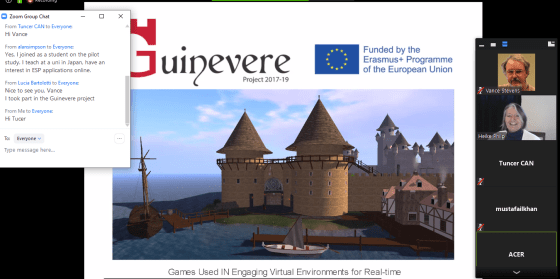
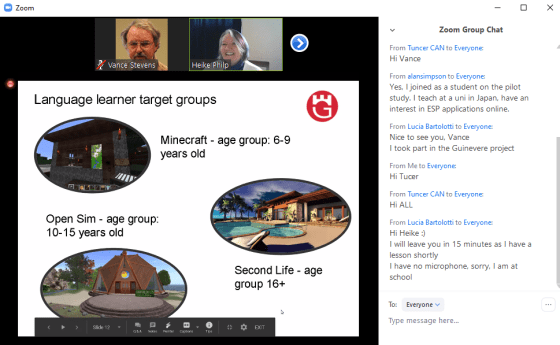
On Wednesday, November 13, 2019, Heike Philp hosted a simulcast from Firenze on educational applications of virtual worlds, and invited me to come on in the Q and A period and talk for 5 min about #evomc20 EVO Minecraft MOOC. My brief appearance followed more comprehensive presentations by Heike herself talking about her #GUINEVERE project,Nick Zwart-Knottnerus of 3DLES on his work in OpenSim, Tuncer Can talking about his app Gistory, and James York presenting on the affordances of Minecraft for language teaching.
GUINEVERE (2017-2019) is a two-year project investigating the potential of digital game-based learning in 3D immersive environments focusing on foreign language learning (2017-2019).As part of the project, language teachers were introduced to the art of designing and processes involved in creating digital games within various VWs including Second Life, OpenSim, and Minecraft.
The project is nearing completion and all of the partner are present in Florence for the final project meeting and look forward to sharing the outcomes. They proudly present the project results in a 2h web conference on Wednesday, 13 Nov 2019 from 11am to – 1pm Italian time.
Heike Philp from let’s talk online will introduce the goal of GUINEVERE and the final results.
11:15am
Project partner Tuncer Can of the Istanbul University-Cerrahpasa will talk about the theoretical framework of Game Design/Gistory App Design Process (soon available from PlayStore and Appstore under the name ‘Gistory’)
11:30am
Project partner IUL and Heike Philp talk about the Teacher Training Course development and the impressive 3D games developed by teachers.
12:00pm
Nick Zwart-Knottnerus of 3DLES presents his work in OpenSim
Q&A with online participants – Vance Stevens has been invited to speak for 5 min about EVO and EVO Minecraft MOOC
Presenters
Guest speaker James York: How to teach languages in Minecraft: What are the affordances of Minecraft for language teaching?
Minecraft offers three different game modes (survival, creative, and adventure) which each have different use cases. In this talk, I provide a list of teaching tips and ideas that have worked for me in my own teaching context with a focus on productive language skills. The talk addresses the affordances of Minecraft for language learning and how teachers can adopt a task-based language teaching approach in this environment.
James is a lecturer at Tokyo Denki University where he conducts research on the pedagogical application of games for language learning. His current main focus is a curriculum development project using tabletop games as the centrepiece of a task-based language teaching and multiliteracies approach to second language acquisition. James is co-editor of Ludic Language Pedagogy, an open access, open peer-reviewed journal exploring games and play, language and literacies, and teaching. James’s previous projects include the development and management of an online Japanese learning community which utilized Minecraft as the domain for interactive, experiential learning activities.
Dr Tuncer Can completed his MA at Istanbul University in 2004 on “Constructivism and Training of Pre-service Foreign Language Teachers”. In 2005, he was granted a Fulbright Scholarship and he spent two terms at Syracuse University, NY, USA, where he taught Turkish via videoconferencing for one year. In 2008, he took part in a project at Istanbul University in the Faculty of Education, English Language Teaching Department, on the implementation of MOODLE in the training of pre-service foreign language teachers; a project was funded by Istanbul University Scientific Research Center. He completed his PhD at Istanbul University in 2011 on “Using Foreign Language Learning Strategies in the Context of Lifelong Learning and Plurilingualism”. Dr. Can also has taken part in three EU Projects. (1) CAMELOT, (2) INTEGRATION OF YOUNG REFUGEES Using mobile devices leading to better language acquisition and relevant career / YouRNI, and (3) TABLIO on the use of tablets for classroom differentiation and inclusion/ TABLIO.
Nick Zwart-Knottnerus is CEO of 3DLES, a Dutch company that offers project management on educational project in virtual worlds. Nick has studied theology and IT in Amsterdam, was an IT teacher for years and built the EU prize-winning virtual language villages Chatterdale and Parolay. He worked for the University of Alcala de Henares in Spain doing research on the use of OpenSimulator for language education. He works for the City University in London as a technical researcher for the aphasia project called EVA Park. 3DLES was partner in several EU projects like TILA, TeCoLa and now the GUINEVERE project.
Heike Philp is CEO of let’s talk online sprl is an edtech and immersive learning integration specialist. Philp co-initiated four European funded projects on teaching and learning a language in real-time at a distance: LANCELOT (LANguage learning with CErtified Live Online Teachers), AVALON (Access to Virtual and Action Learning live ONline) and CAMELOT (CreAting Machinima Empowers Live Online language Teaching and learning) and GUINEVERE (Games Used IN Engaging Virtual Environments for Realtime language Education). Philp founded and organizes several web conferences, Virtual Round Table (language learning technologies) DaFWEBKON (teachers of German), SLanguages Annual Symposium. She co-owns EduNation islands in Second Life.
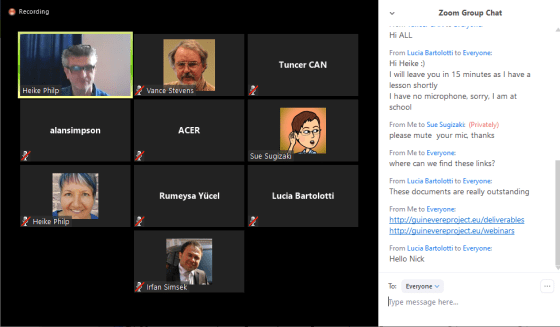
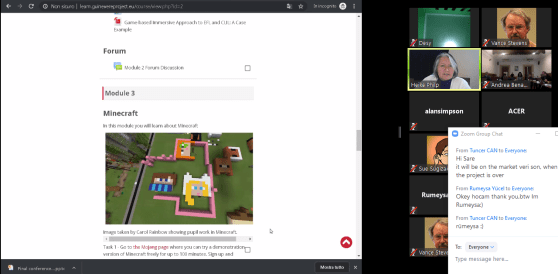
Screenshots and text chat logs
05:56 PM Me (Vance): Heike is muted (she then requests a sound check)
06:01 PM alansimpson: Fine sounds good.
06:01 PM Me: fine (Heike then requests introductions in text from the audience)
06:09 PM Me: I’m a coordinator of EVO Electronic Village Online and moderator EVO Minecraft MOOC which starts its 6th session in Jan-Feb
06:09 PM Tuncer CAN: Hi Vance
06:09 PM alansimpson: Yes, I joined as a student on the pilot study. I teach at a uni in Japan, have an interest in ESP applications online.
06:09 PM Lucia Bartolotti: Nice to see you, Vance. I took part in the Guinevere project
06:09 PM Me: Hi Tuncer
06:10 PM Tuncer CAN: Hi ALL
06:14 PM Lucia Bartolotti: Hi Heike 🙂 I will leave you in 15 minutes as I have a lesson shortly. I have no microphone, sorry, I am at school
06:51 PM Heike Philp: hi James, great to see you
06:51 PM James York: Thanks for inviting!
06:58 PM Rumeysa Yücel: thank you tuncer cam but how can we find this app, cause when I searched ,I couldn’t find it
06:58 PM James York: Thanks Heike
From Tuncer CAN: 07:00 PM
Hi Sare
it will be on the market veri son, when the project is over
From Rumeysa Yücel: 07:00 PM
Okey hocam thank you,btw Im Rumeysa:)
07:01 PM Tuncer CAN: rümeysa 🙂
07:05 PM Me: hmmm – I would like to join the next one (in response to learning that participants in one of Heike’s projects overwhelming gravitated to Second Life; only one to Minecraft)
07:06 PM James York: All good 🙂
07:09 PM Me: what is the link you are showing (when you get a moment) http://learn.guinevereproject.eu
07:17 PM James York: ?? – Well remembered!
07:20 PM Vance Stevens: 6th one (I hold up 6 fingers in video, indicating that we are about to enjoy our 6th EVO Minecraft MOOC session coming up next January-February)
07:21 PM alansimpson: Great, fine. (must be in response to a sound check)
07:24 PM Me: I know the feeling – Minecraft is easy … Zoom? (James is having trouble navigating in Zoom; he seems to get around fine in Minecraft 🙂 07:27 PM Heike Philp: fine
07:44 PM James York: Slides from me http://bit.ly/34YkGyq
07:50 PM Heike Philp: Any questions from the audience about GUINEVERE and for James or for Vance?
07:50 PM James York: http://minecraftmooc.org/
07:51 PM Heike Philp: James was faster than me
07:51 PM James York: hehe – Keen to join actually! Ty ty vance
07:51 PM Heike Philp: James do you have a link to your TED session?
07:53 PM James York: https://www.youtube.com/watch?v=gokaQuqIAwM
Is Jeff Kuhn still involved? In the MOOC (If he ever was?)
07:53 PM Heike Philp: he was
07:54 PM James York: gotcha
Thanks for the information!
I have read your paper
Christine Coombe TESOL Webinar Nov 8 on participation in professional organizations
The announcement was sent out on TESOL lists Nov 7 and this event was over by the time I opened the mail, but for the record:
Sun 10 Nov 1400 UTC EVO Moderator Professional Development Week 4 Live Event
The coordinating team and the members of the EVO (http://evosessions.pbworks.com) Moderator Professional Development Week 4 invited EVO coordinators and moderators to a scheduled Zoom meeting. Learning2gether invited others who felt they would have something to contribute.
Topic: Week 4: Getting ready to go live
Time: Nov 10, 2019 at 2 PM UTC and 09:00 AM Eastern Time (US and Canada)
Below find a video embed of this session starting at 25 min 35 seconds, which is where Nellie asked for moderators to come on and discuss the online spaces they had chosen for their sessions. First up was Graham Stanley, who spoke about how his Escape the Room session is organized, and he invited Vance Stevens to join him in the discussion, https://youtu.be/0W–5Kuk2mA?t=1535





















 🙂
🙂 








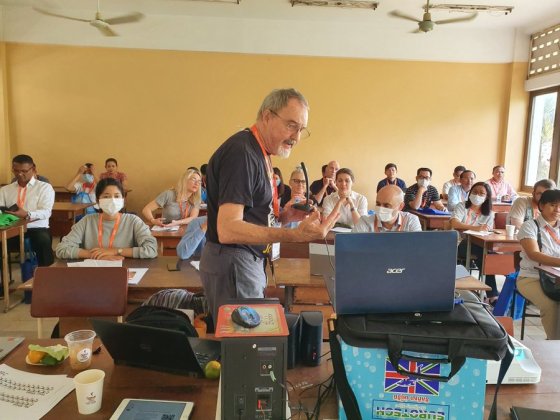
 Picture posted on Facebook by Christel Schneider, used here with permission






 Learning2gether