Sunday July 15, 2012 – Luis Arnoldo Ordoñez, MOOCs and CAMELs
Luis Ordóñez will be offering a MOOC (in Spanish) about performing collaborative research in social sciences. The idea is to help graduate students to develop collaborative research for their requested theses. Perhaps education students in the areas of language or educational technologies might be interested in learning more about this course. They can get information at http://interconectados.org/los-camel/camel-investigaciones-colaborativas-en-ciencias-sociales/ (easily translated).
Luis referred more than once to this picture by Stephen Downes
CAMEL is a Spanish achronym for Curso Abierto Masivo En Linea
Luis works at Universidad Simón Bolivar in Venezuela teaching the seminar for citizen involvement in the Doctoral Program in Social Sciences, and he is the President of Fundación Interconectados which aims to insert digital technologies in our society.
It’s summertime. Self-respecting teachers are many away on holiday. So how can they engage in Learning2gether? Well, summertime is good for just hanging out.
This Sunday, 1400 GMT, Vance is planning to Hangout in Google Hangout with Jeff Lebow. That’s about all that’s planned, (except that you’re invited 🙂 We’ll catch up with Jeff, find out what he does in 27 teaching hours a week there in Pusan Korea, what he’s got planned for EdTech Weekly, and who’s minding the server over there at WorldBridges, wherever that is 🙂
Graham’s friends and professional contacts plan to talk an hour or two about Graham Davies, who passed away in late June, 2012. If you knew Graham, or knew of him and would like to know more, please join us and contribute your recollections. We can all continue learning from Graham by exploring his legacy online.
Graham was recorded at the Virtual Round Table April 23, 2010 event, as part of a panel associated with EUROCALL: http://virtual-round-table.ning.com/events/panel-discussion-connected-and. Panelists included Graham Davies, Stephen Bax, John Gillespie, and Vance Stevens. Francoise Blin was also included as well as Ingred (from Austria).
Graham was recorded on November 13, 2009 as part of a panel at the Lancelot Schools’s Virtual Round Table Conference hosted by Heike Philp: http://virtual-round-table.ning.com/events/virtual-panel-discussion-those. Besides Graham, panelists included Vance Stevens, Ton Koenraad, and Duane Sider (from Rosetta Stone)
Time: July 1, 2012 from 1pm to 3pm Location: EuroCALL Headquater in Second Life and Adobe Connect for the stream Organized By: Heike Philp aka Gwen Gwasi
Graham Davies, the grand seigneur of EuroCALL passed away on Thursday, 21st of June (2 weeks after his 70th birthday) after a long battle with cancer. He was married since 1968, with two daughters, two granddaughters and one grandson. He spoke fluent German and tolerable French, and dabbled in Russian, Hungarian, Italian and Spanish. In his free time he swam in the pool at his local Holiday Inn, played golf when the weather was fine, and I went skiing in Austria each winter. He walked at least a mile every day with their greyhound. Their family have adopted retired racing greyhounds as pets for over 30 years.
He celebrated his 64th birthday in Brussels three months after undergoing major surgery for a very rare form of cancer known as PMP (Pseudomyxoma Peritonei). He kept a diary of his battle with PMP under Survivor’s Story. He reached the age of 65 in 2007 and described himself as “happily retired” – although still finding plenty of things to do.
Graham began his career as a teacher of German and French in secondary education in 1965, moving into higher education in 1971. From 1971 to 1993 he taught German and managed the multimedia language centre at Ealing College, which was later integrated into Thames Valley University (now known as the University of West London). He had been involved in Computer Assisted Language Learning (CALL) since 1976.
In 1982 he wrote one of the first introductory books on computers in language learning and teaching, which was followed by numerous other printed and software publications. In 1989 he was conferred with the title of Professor of CALL.
Graham Davies was the Founder and President of EUROCALL, holding the post from 1993 to 2000, and I served as a member of the EUROCALL Executive Committee from 2000 to 2011. He was also actively involved in the organisation of two WorldCALL conferences in 1998 and 2003. WorldCALL is a worldwide umbrella organisation that aims to assist countries that are currently underserved in the area of ICT and the teaching and learning of modern foreign languages.
Graham took early retirement from full-time teaching in 1993, but worked part-time as a Visiting Professor for Thames Valley University until 2001, assisting in the management of a number of EC-funded projects. He held the status of Emeritus Professor of Computer Assisted Language Learning and I did occasional external examining of his MPhil and PhD students and kept himself busy by editing the ICT for Language Teachers Website http://www.ict4lt.org where he managed the ICT for Language Teachers Blog <http://ictforlanguageteachers.blogspot.be>. Graham lectured and ran ICT training courses for language teachers in 22 different countries and sat on a number of national and international advisory boards and committees.
With a lot of passion he kept investigating the possibilities of language learning and teaching in Second Life. Graham was responsible for maintaining a presence for EUROCALL in Second Life and liaising with CALICO, EUROCALL’s affiliated association in the USA. EUROCALL and CALICO share a Headquarters on one of the EduNation Islands in Second Life, and we have set up a joint Virtual Worlds Special Interest Group (VW SIG). His avatar name in SL was Groovy Winkler, and Sally can be found there too as Flopsy Bookmite.
Helaine (Laine) directs the Language Teacher Education Programs at LIU – Hudson – Graduate Centers of Long Island University, USA. She collaborates with her colleague, Nancy Lemberger from LIU-Brooklyn on cross-campus online programs in TESOL and Bilingual Education.
For this session, Laine will share her experience flipping her Fundamentals of Linguistics class this spring semester for the first time. There were many surprises in what occurred when she decided to try the flip. She hopes to generate discussion on the rationale for the flipped classroom, what students and courses are best suited for this model and how it has worked out in her class. One of her students, Edith Ramirez-Lopez, will join in to provide the learner perspective.
Host: CourseSites (from Blackboard) announces a Massive Open Online Course (MOOC)
Audience: Thousands of Blackboard, CourseSites, and other online and blended learning instructors around the world.
Description: Motivating students and creating community within blended and online learning environments is crucial to academic achievement and success. This open course will provide both theoretical concepts and practical tools for instructors to improve motivation, retention, and engagement within blended and online courses.
4. Question and Answer (Q&A) Session: Wednesday May 23th; 4 PM EST (Up to two hours of Q&A)
5. Blackboard/CourseSites Overview: Wednesday May 30th; 4 pm EST
Twitter Note: The Twitter hashtag will be: #bonkopen
About Dr. Curtis Bonk: Curt Bonk is Professor of Instructional Systems Technology at Indiana University and President of CourseShare. Drawing on his background as a corporate controller, CPA, educational psychologist, and instructional technologist, Bonk offers unique insights into the intersection of business, education, psychology, and technology. A well-known authority on emerging technologies for learning, Bonk reflects on his speaking experiences around the world in his popular blog, TravelinEdMan. He has coauthored several widely used technology books, including The World is Open, Empowering Online Learning, The Handbook of Blended Learning, and Electronic Collaborators.
4 Reasons Why the Bonk MOOC is So Interesting, posted April 25, 2012 By Joshua Kim
Bonk, C. J. (2012, May). Participants, Questions & Answers, Demonstrations, and Reflections. Week 5 presentation at Blackboard/CourseSites Massive Open Online Course (MOOC): Instructional Ideas and Technology Tools for Online Success, Online from Bloomington, IN. Available:
Bonk, C. J. (2012, May). The Rise of Shared Online Video, the Fall of Traditional learning. Week 4 presentation at Blackboard/CourseSites Massive Open Online Course (MOOC): Instructional Ideas and Technology Tools for Online Success, Online from Bloomington, IN. Available:
Bonk, C. J. (2012, May). 50+ (actually 75) Hyper-Engaging Ideas: Critical, Creative, Cooperative. Week 3 presentation at Blackboard/CourseSites Massive Open Online Course (MOOC): Instructional Ideas and Technology Tools for Online Success, Online from Bloomington, IN. Available:
Bonk, C. J. (2012, May). Blackboard/CourseSites MOOC Part I1: Where Are You R2D2?: Addressing Diverse Learner Needs with the Read, Reflect, Display, and Do Model. Week 2 presentation at Blackboard/CourseSites Massive Open Online Course (MOOC): Instructional Ideas and Technology Tools for Online Success, Online from Bloomington, IN. Available:
Bonk, C. J. (2012, May). Blackboard/CourseSites MOOC Part 1: The TEC-VARIETY model. Week 1 presentation at Blackboard/CourseSites Massive Open Online Course (MOOC): Instructional Ideas and Technology Tools for Online Success, Online from Bloomington, IN. Available:
Google ‘Craig Kapp NYU ZooBurst’ to find sites such as:
“Zooburst is a web-based digital storytelling tool designed to facilitate personal expression through the creation of interactive 3D pop-up books. Using a simple drag-and-drop interface, Zooburst lets anyone quickly construct immersive 3D worlds that can be experienced online or in the palm of your hand using a standard webcam and a printed piece of paper.” from https://itp.nyu.edu/itp/gallery/projectDetail.php?t=26&id=3171
Shandin Pete and Robert Squires will introduce Education Across Cultures, a graduate-level open online course in multicultural education offered through The University of Montana.
Education across Cultures is a 7 week online course that runs from Monday, June 11 – Friday, July 27, 2012. The course is designed for those interested in multicultural education and promoting understanding and respect for diverse cultures in the design and delivery of educational experiences. It is a Masters level course in Curriculum and Instruction at The University of Montana that may be taken as part of an advanced degree or just for personal interest (non-credit). A variety of social media tools will be used to foster interaction and learning. The course will be designed and delivered in Moodle.
Learning Outcomes
On completion of this course, participants will be able to:
Recognize historical, economic, psychological, and social factors that have influenced present day social conditions for many culturally diverse groups in the United States;
Analyze current issues in multicultural education through investigating definitions of culture and diversity and its importance for the global educational system;
Appraise the current application of multicultural education in the U.S. Education system;
Create a work-plan for promoting social justice in a particular institutional context;
Critically evaluate their personal values on multicultural education.
No need to buy anything. Just bring yourself and your interests. Readings, resources, tools will be provided. Scheduled sessions will include thought leaders in the field.
The participants were involved in similar courses:
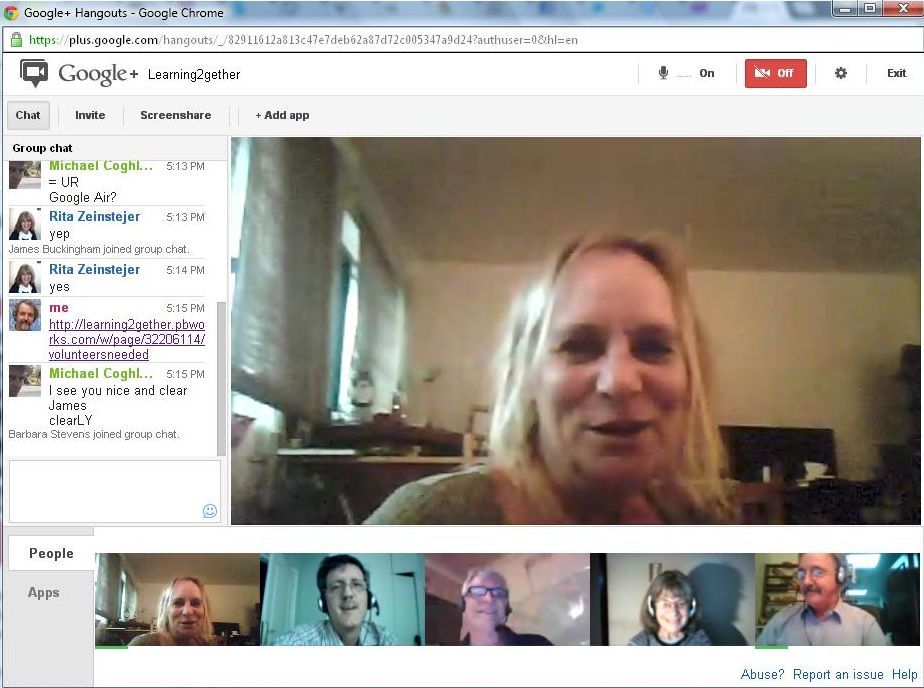
Vance Stevens started a Google+ Hangout and hosted a discussion of how Google Hangouts can be recorded, hopefully doing just that in the process. This should eventually become a standard feature with Google Hangouts, but unfortunately live stream ON AIR shows are not available to everyone yet. Therefore we tried some of the other tools available to make a recording of the proceedings, using the tools curated at this Scoop.it
Google Plus Hangouts on Air feature now available to all users
However it mentions the caveat that “Google had added the ability for a limited group of people to be able to broadcast their Hangouts to the world.Google has just announced that Hangouts On Air is now available to all Google+ users worldwide. It will be a gradual rollout though so the system doesn’t get overwhelmed all at once.
but unfortunately, I’m on the dark side of the world
According to this page, this is how it will work once the rollout is complete: With Hangouts on Air, you will be able to broadcast yourself publicly to the entire world, see how many viewers you have, and even record and reshare your broadcast. The public recording will be uploaded to your YouTube channel and to your original Google+ post.
The NEXT best way to do this is to use the Jeff Lebow method at his Book of GoogleCasting
Watching the video with clear, explicit directions, I realized I would need a USB mic. Now, I HAD one but lost it at a recent conference where I had been broadcasting, so with just 20 min. before show time, I discovered I didn’t have mine :-((
Amy apparently didn’t know that Pixetell was acquired by a black knight and taken down in May 2011: <http://en.wikipedia.org/wiki/Pixetell>.
So we were down to the following 4 options …
Screencastle: <http://screencastle.com/> – I’ve tried this before, couldn’t get it to work – Jim couldn’t get it to upload tonight either 😦
Screenr is another option, but with only 5 minutes recording time, not robust enough for Hangouts: <http://www.screenr.com/> (and we found the same constraint with Jing, <http://jingproject.com>
The final option of the 5 is Screencast-o-matic, which is what Jeff Lebow uses, and if Jeff says this requires a USB mic, I have a hunch it ain’t gonna work. So we didn’t try <http://www.screencast-o-matic.com/watch/c6lIFqX3H>
Ok, show time. Starting my hangout, Jeff mentioned he made his public but when I did that it immediately began filling with strangers, so I started a new one and invited my Professional Contacts circle only.
This netted the ‘right’ sort of people, like Rita Zeinstejer, Michael Coghlan, Jim Buckingham and his cat, and eventually Elizabeth Anne – We know that Dan Bassill tried to join, and my wife Bobbi put in a cameo appearance (with our cat :-).
The task was to get the recordings going. Jim tried to record on Screencastle but it didn’t seem to want to upload. In the end we successfully made recordings using Screenr, Jing, and BB Flashback. As Jeff could have told us, none of these picked up sound card audio, so we ended up with three recordings in which only the person doing the recording can be heard talking. Obvously this needs to be done with USB mic in order to record using 3rd party software; or alternatively wait for Google to roll out Google Air worldwide.
Rita recorded using Jing, limited to 5 min, and no sound card audio
Meanwhile, I was downloading and installing BB Flashback Express. I think this gave best results because the recording time was unlimited. The installation required slowed my computer and consumed so much resources that the screen went black much of the time, yet the recorder captured it all in the background, and the results are quite amusing (I put the recording at the start of this post so you could stop it playing easily, but you can see in the screen shot below how amused everyone was 🙂
And then, Michael went to bed in Australia, Jim went to dinner in UAE, and Rita and Elizabeth and I moved over to …
Michael Coghlan is seeking feedback on what’s up and coming for educational technology in the near and long terms for the next Horizon Report due to come out soon. He will meet us at 13:00 GMT in Elluminate and brainstorm on the topic. More information will be posted soon; meanwhile read Michael’s postings to the Webheads list:
For example, the two trends for the current round are:
5. Openness – concepts like open content, open data and open resources, along with notions of transparency and easy access to data and information – is moving from a trend to a value for much of the world.As authoritative sources lose their importance, there is need for more curation and other forms of validation to generate meaning in information and media.
6. Legal notions of ownership and privacy lag behind the practices common in society. In an age where so much of our information, records, and digital content are in the cloud, and often clouds in other legal jurisdictions, the very concept of ownership is blurry.
Michael asks us
What are the implications for each of these trends in your institution?
What are you doing already to accommodate these trends? Or, what could you do to accommodate them?
This was a F.U.N. session. While we were chatting in Elluminate, Sand Rogers opened a Hangout which attracted some additional listeners who wanted to be seen as well as heard in Elluminate:
Ater the session ended, the F.U.N. began anew with Sand, Tuba, and Nina taking Hangout for a spin. We played with the Google effects and learned how the apps worked for YouTube, screenshare, and Slideshare. We were disappointed though that Google has not rolled out one-click recording … yet …







 Learning2gether