Shandin Pete and Robert Squires will introduce Education Across Cultures, a graduate-level open online course in multicultural education offered through The University of Montana.
Education across Cultures is a 7 week online course that runs from Monday, June 11 – Friday, July 27, 2012. The course is designed for those interested in multicultural education and promoting understanding and respect for diverse cultures in the design and delivery of educational experiences. It is a Masters level course in Curriculum and Instruction at The University of Montana that may be taken as part of an advanced degree or just for personal interest (non-credit). A variety of social media tools will be used to foster interaction and learning. The course will be designed and delivered in Moodle.
Learning Outcomes
On completion of this course, participants will be able to:
Recognize historical, economic, psychological, and social factors that have influenced present day social conditions for many culturally diverse groups in the United States;
Analyze current issues in multicultural education through investigating definitions of culture and diversity and its importance for the global educational system;
Appraise the current application of multicultural education in the U.S. Education system;
Create a work-plan for promoting social justice in a particular institutional context;
Critically evaluate their personal values on multicultural education.
No need to buy anything. Just bring yourself and your interests. Readings, resources, tools will be provided. Scheduled sessions will include thought leaders in the field.
The participants were involved in similar courses:
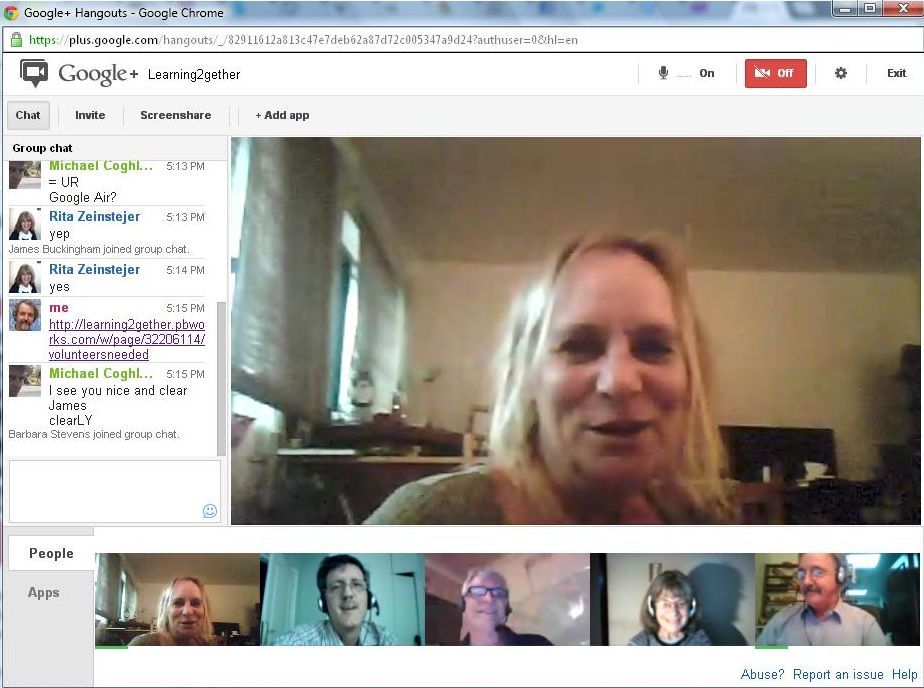
Vance Stevens started a Google+ Hangout and hosted a discussion of how Google Hangouts can be recorded, hopefully doing just that in the process. This should eventually become a standard feature with Google Hangouts, but unfortunately live stream ON AIR shows are not available to everyone yet. Therefore we tried some of the other tools available to make a recording of the proceedings, using the tools curated at this Scoop.it
Google Plus Hangouts on Air feature now available to all users
However it mentions the caveat that “Google had added the ability for a limited group of people to be able to broadcast their Hangouts to the world.Google has just announced that Hangouts On Air is now available to all Google+ users worldwide. It will be a gradual rollout though so the system doesn’t get overwhelmed all at once.
but unfortunately, I’m on the dark side of the world
According to this page, this is how it will work once the rollout is complete: With Hangouts on Air, you will be able to broadcast yourself publicly to the entire world, see how many viewers you have, and even record and reshare your broadcast. The public recording will be uploaded to your YouTube channel and to your original Google+ post.
The NEXT best way to do this is to use the Jeff Lebow method at his Book of GoogleCasting
Watching the video with clear, explicit directions, I realized I would need a USB mic. Now, I HAD one but lost it at a recent conference where I had been broadcasting, so with just 20 min. before show time, I discovered I didn’t have mine :-((
Amy apparently didn’t know that Pixetell was acquired by a black knight and taken down in May 2011: <http://en.wikipedia.org/wiki/Pixetell>.
So we were down to the following 4 options …
Screencastle: <http://screencastle.com/> – I’ve tried this before, couldn’t get it to work – Jim couldn’t get it to upload tonight either 😦
Screenr is another option, but with only 5 minutes recording time, not robust enough for Hangouts: <http://www.screenr.com/> (and we found the same constraint with Jing, <http://jingproject.com>
The final option of the 5 is Screencast-o-matic, which is what Jeff Lebow uses, and if Jeff says this requires a USB mic, I have a hunch it ain’t gonna work. So we didn’t try <http://www.screencast-o-matic.com/watch/c6lIFqX3H>
Ok, show time. Starting my hangout, Jeff mentioned he made his public but when I did that it immediately began filling with strangers, so I started a new one and invited my Professional Contacts circle only.
This netted the ‘right’ sort of people, like Rita Zeinstejer, Michael Coghlan, Jim Buckingham and his cat, and eventually Elizabeth Anne – We know that Dan Bassill tried to join, and my wife Bobbi put in a cameo appearance (with our cat :-).
The task was to get the recordings going. Jim tried to record on Screencastle but it didn’t seem to want to upload. In the end we successfully made recordings using Screenr, Jing, and BB Flashback. As Jeff could have told us, none of these picked up sound card audio, so we ended up with three recordings in which only the person doing the recording can be heard talking. Obvously this needs to be done with USB mic in order to record using 3rd party software; or alternatively wait for Google to roll out Google Air worldwide.
Rita recorded using Jing, limited to 5 min, and no sound card audio
Meanwhile, I was downloading and installing BB Flashback Express. I think this gave best results because the recording time was unlimited. The installation required slowed my computer and consumed so much resources that the screen went black much of the time, yet the recorder captured it all in the background, and the results are quite amusing (I put the recording at the start of this post so you could stop it playing easily, but you can see in the screen shot below how amused everyone was 🙂
And then, Michael went to bed in Australia, Jim went to dinner in UAE, and Rita and Elizabeth and I moved over to …
Michael Coghlan is seeking feedback on what’s up and coming for educational technology in the near and long terms for the next Horizon Report due to come out soon. He will meet us at 13:00 GMT in Elluminate and brainstorm on the topic. More information will be posted soon; meanwhile read Michael’s postings to the Webheads list:
For example, the two trends for the current round are:
5. Openness – concepts like open content, open data and open resources, along with notions of transparency and easy access to data and information – is moving from a trend to a value for much of the world.As authoritative sources lose their importance, there is need for more curation and other forms of validation to generate meaning in information and media.
6. Legal notions of ownership and privacy lag behind the practices common in society. In an age where so much of our information, records, and digital content are in the cloud, and often clouds in other legal jurisdictions, the very concept of ownership is blurry.
Michael asks us
What are the implications for each of these trends in your institution?
What are you doing already to accommodate these trends? Or, what could you do to accommodate them?
This was a F.U.N. session. While we were chatting in Elluminate, Sand Rogers opened a Hangout which attracted some additional listeners who wanted to be seen as well as heard in Elluminate:
Ater the session ended, the F.U.N. began anew with Sand, Tuba, and Nina taking Hangout for a spin. We played with the Google effects and learned how the apps worked for YouTube, screenshare, and Slideshare. We were disappointed though that Google has not rolled out one-click recording … yet …
This study investigated beliefs of members of an online Community of Practice (WIA) on the role of the community on professional development, teaching, and on Web 2.0 use. Through the analyses of the questionnaire, it was aimed at finding out the members’ ideas about the group as an online CoP and benefits of belonging to an online CoP.
The data were collected from seventy nine members of the Webheads in Action from various countries by using an online questionnaire. Then, the responses to the multiple choice items were analyzed using PASSW. The data collected from the last section of the questionnairre were analyzed through content analysis and pattern coding.
The findings revealed that the members believe that WIA plays an important role in the process of developing multiltiteracies skills and the Web 2.0 tools used in classroom teaching and for professional development. The findings further revealed that the participants believe that being a WIA member leads to motivation, collaboration and discovery. These beliefs are thought to provide insights about the advantages and disadvantages of learning in online CoPs and their effects on the members’ Web 2.0 use.
The findings can also be beneficial for researchers, teacher trainers, and teachers wishing to join CoPs for professional development. They can understand the advantages and disadvantages, and the participation process in more detail. Moreover, these findings can indicate that online CoPs can provide a medium for coping with the increasing amount of information thanks to the recent technological developments, and acquiring new skills.
Today, Scott Lockman describes his understanding of what ds106 is, how the system works, how to become involved, and some of his experience over the past year of teaching a computer studies classbased on the ds106 model.
This Sunday, Scott was at Tapped In two hours before he was due to go on, giving us plenty of time to set up the Elluminate room, but one thing led to another and we ended up at a place called Cypris Chat in Second Life <http://cyprischat.org/> where students come together and talk freely on interestingly abstract concepts. Here’s a screen shot of the F.U.N.
This engaged us in a round of getting our VOIP working in SL where we could hear the chat, necessitating our shutting off sound in Elluminate, and causing us to get so resource-challenged that we both had to reboot and barely made it back to Elluminate in time to get re-started there in time for …
getting back on the topic of tonight’s presentation on ds106 …
Vance Stevens, Nellie Deutsch, Robert Squires, Susan Burg, Carla Arena, Teresa Almeida d’Eca, Heike Philp, Scott Lockman, Laine Marshall, Kalyan Chattopadhyay, and Mary! …
Dan Bassill of the Tutor/Mentor Institute, LLC describes the four part strategy he has developed to support the growth of a mentor-based youth-development strategy and how it might be applied to problem-solving process in any social sector and in any country. Dan will also talk about how youth in high schools and colleges can take a significant role in this process and how this will enhance their own learning, problem solving and communications skills while also creating future leaders who are better prepared to solve social and environmental problems via world-wide learning and collaboration. Dan says “While I apply this strategy to what I do to help kids in poor neighborhoods of Chicago, I feel the model applies to any problem solving effort.” You can review the 4 part strategy at http://tinyurl.com/TMC-4-Part-Strategy.
Dan talked about how he conceives channeling knowledge into action through a 4-part strategy he articulated through mindmaps and other visuals. His work has a lot in common with that of Webheads, MOOCs, and EVO (which I have argued possibly IS a MOOC) in that he taps cognitive surplus to leverage volunteer effort while trying to scale and sustain through getting the attention of (i.e. the information out to) the business community to show them how their interests coincide with those of the Tutor/Mentor Institute.
Dan points us to
http://www.simschool.org/ “I get their newsletter and this looked like an interesting tool to support ELS as well as regular learning.”
the Learning Change Project: “in each of 8 sections it talks about a different part of a learning strategy and it points to PDFs and deeper reading that anyone can use. http://gfbertini.wordpress.com/about/ … this is related to the ideas of MOOCs that [Vance] wrote about last year. If these can be focused on specific issue areas, rather than generic learning, they could be powerful platforms for social problem solving.”
March 29=31 is the 2012 International TESOL convention in Philadelphia and onceagain the CALL-IS will be broadcasting select sessions in real time for those that can’t be there (or those that want to multitask on their laptops at the convention).
CALL-IS would love to have you participate in any or all of the webcasts. Justvisit http://www.call-is.org/info/mod/resource/view.php?id=379 and click on the webcast that interests you. We’ll be taking questions from the online audience and there is always a lively chat during the presentation.
Post conference, links to the recorded sessions will go up and folks that couldn’t participate in real time can still benefit.
Oh, and all of this is free, courtesy of the CALL-IS interest section.
Vance Stevens gave a presentation entitled Learner-centered do-it-yourself LMS at the 6th eLearning in Action conference held at the Sharjah Higher Colleges of Technology, UAE
In fact, the Feb 8 presentation was a rationale for the topic, whereas this latest presentation focuses more on the tools and resulting websites for putting together a DIYLMS.
Elizabeth Anne agreed to host a Learning2gether event at 1400 GMT on Sunday April 1 to be a discussion of reflections on the recent IATEFL conference, and IATEFL Online.




 Learning2gether