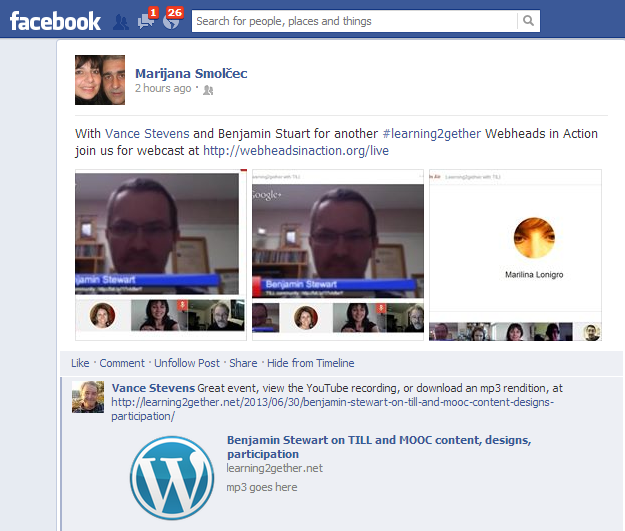
Benjamin Stewart is “always interested in collaborating/cooperating with other educators. I’m participating in an Online Pedagogy MOOC and plan to participate in the scenarios planning MOOC at Wikieducator. I’m always curious about discussing with others not only MOOC content but MOOC designs/participation as well. I’m intrigued how others view distance courses and usually come from this perspective when I conduct online (informal) discussions. I usually try to ask more questions than I answer. 🙂
Benjamin tends to ask those questions in Hangouts on TILL, Teachers for Interactive Language Learning, a Google+ community
Informal pedagogical discussion for anyone interested in TESOL, general education, and/or ed. technology.
Fabrizio Bartoli, Lucia Bartolotti, Claude Almansi, Luisella Mori, and 480 others recently participated in a MOOC, more specifically a “cMOOC” (as described here )
Lucia writes: “Our ten-week cMOOC has just closed, with the collective decision to go on as a community, with new group initiatives springing out of it.
The creator of the cMOOC is professor Andreas Formiconi, from University of Florence and IUL-Italian University Line, which is a partnership of four Universities offering online courses to teachers.
A few interesting figures about the success of the cMOOC can be read here; those of you who can read some Italian can access some more detail through this poster, which was prepared for a Conference on Universities and Life-long Learning.”
Meantime you can learn the interesting story of how this event transpired by reading the comments at this blog post:
Thank you so much for the great meeting and for having already posted
its recordings on your blog. I’m attaching the saved chat – slightly
edited version (1) in http://piratepad.net/learning2gether-ltis13 .
(This contains Claude’s running commentary and translation in Italian of what we said during the session)
Amara remains an interesting tool for language learning activities,
though less so than when it was called Universal Subtitles, because
its developers have curtailed some heterodox uses since the change of
name – which coincided with their financing themselves with pro
services: pro customers apparently don’t like to have N subtitle
tracks for the same language :D. And it’s become more bug-prone too.
Nonetheless, I’ve set up small activities with it within 2 of Andreas
Formiconi’s online courses: #ltis13 and the former #linf12, and both
times, the participants involved found it very easy to master, even
though they had no previous subtitling experience. In the #linf12
instance, what triggered the activity was a post by Andreas about the
Cloud with three rather technical video tutorials that several
participants found hard to understand.
Best wishes
Claude
Also earlier this week:
Sat June 22 1400 GMT – Nellie Deutsch interviews Bryan Alexander on Moodle MOOC
Thomas Hodgers writes: I was able to see and hear both you and Bryan throughout todays presentation Week 4: MOOCs & Ubiquitous Computing, but the Recording of the session has … no video or voice for Bryans presentation. I hope somebody was able to record everything!
What?
Nellie’s special guest for this session is Dr. Bryan Alexander (according to Nellie, accredited with coining the MOOC). Dr. Alexander will be discussing online learning vs. ubiquitous computing.
How does learning change as we enter the era of ubiquitous computing? What does the MOOC furor tell us about emerging education? It is possible that we will have to rethink many aspects of schooling, from information architecture to academic labor. Institutional learning may suffer a classic economic disruption, or it may transform into a new, networked entity.In the presentation, Dr. Alexander and the participants will examine drivers of change, along with several possible futures.
Learning2gether monitored a number of events taking place this weekend from Saturday June 15 to Monday June 17, 2013. Probably the most listenable recording was the one above, from Stephen Downes, being interviewed by Nellie Deutsch for Moodle MOOC on Saturday.
Monday June 17 – Jeff Lebow streams ‘English SOS’ (Speaking Online Show)
Brought to you by Jeff Lebow’s courageous ENG317 students at Busan University of Foreign Studies, Jeff has adapted Hangouts to motivating his students to connect with native speakers and practice English online. In this event, we witnessed a delightful series of presentations by Jeff’s students, who bring a lot of creativity to the hangouts. In response to announcements (on the Webheads list <http://groups.yahoo.com/group/evonline2002_webheads/message/30479> and on Learning2gether) Carol Yeager, Rita Zeinstejer, and Vance joined in the text chat in this session which coincided with time for Learning2gether.
This recording features, among other presentations
A perspicacious talk about a Korean reality show where celebrities are shown spending time with their children, which strikes a chord in Korea
A delightful Kim Bop cooking lesson
According to Jeff, the students have all consented to having their recordings posted online. Details about all English SOS segments can be found at: http://englishbridges.net/live.
Jeff and his students will be streaming live as well at the following time this week, and beyond that Jeff is hoping to expand the concept to include students worldwide.
Date: Sat., June 15, 2013
Time: 9:00am PST/10:00am MST/11:00am CST/12:00pm ESTTime where you are, 20:00 GMT: http://www.timeanddate.com/worldclock/fixedtime.html?msg=Classroom+2.0&iso=20130615T09&p1=137&ah=1
Location: http://tinyurl.com/cr20live (http://tinyurl.com/cr20live)Kim Caise, Lorna Costantini and Peggy George will be hosting another Classroom 2.0 LIVE show. As an extension to the Classroom 2.0 Ning community, Classroom 2.0 “LIVE” shows are opportunities to gather with other educators in real-time events, complete with audio, chat and desktop sharing. A Google calendar of upcoming shows is available at http://live.classroom20.com/calendar.html.Join us Saturday, June 15th, when Christiana Cantrill and Paul Oh of the National Writing Project, Paul Allison of the National Writing Council, and Karen Fasimpaur, will present ”Summer of Making and Connecting”. The team of presenters will discuss the use of writing and technology to make connections and collaborate with other students on global projects including, “Youth Voices” and the “National Writing Project”.More information and details are at http://live.classroom20.com. If you’re new to the Classroom 2.0 LIVE! show you might want to spend a few minutes viewing the screencast on the homepage to learn how we use Blackboard Collaborate (formerly Elluminate), and navigate the site. Each show begins at12pm Eastern (GMT-5) and may be accessed in Blackboard Collaborate directly using the following Classroom 2.0 LIVE! link at http://tinyurl.com/cr20live.On the Classroom 2.0 LIVE! site (http://live.classroom20.com) you’ll find the recordings of previous sessions.
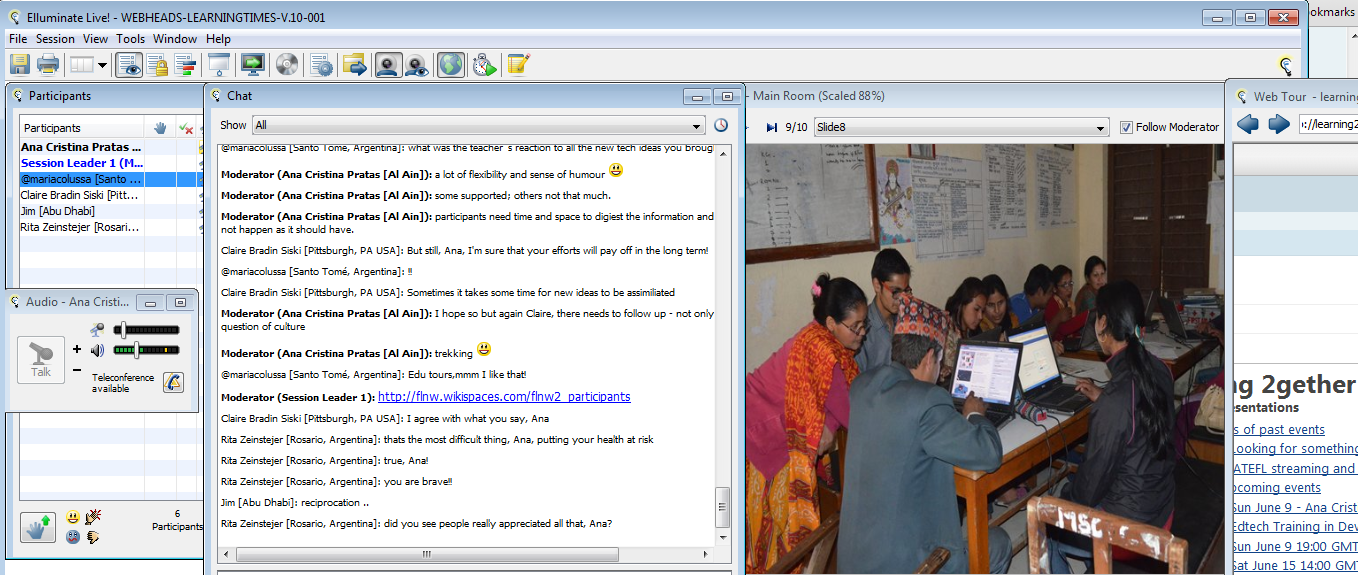
Cristina shared with us how her involvement in schools in Nepal began and her insights on the risks and demands of doing voluntary edtech training in developing counties.
If you have served as a volunteer in developing countries, or if you are interested in the concept, please join the discussion.
Vance related this to his experiences with FLNW in Thailand in January 2008:
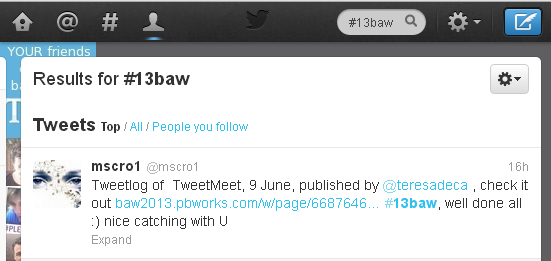
A Tweetmeet is where users of a common #hashtag communicate synchronously on Twitter.
BaW coordinator Teresa Almeida d’Eca notes that BaW have done this before. The intro to the TweetMeet2 page recaps a recent one: “it all boils down to going to Twitter and start messaging with the (to be announced) hashtag.” http://baw2012.pbworks.com/w/page/53587722/TweetMeet2
The hashtag for this one is #13baw – As Teresa says “It’s totally free of people at this point”
The conversation will take place using a Google+ Hangout on Air and be streamed along with a text chat at http://edtechtalk.com/live-glass. If you’d like to join the conversation as a participant, please post a comment on our Event Listing at: http://bit.ly/11aE9bW
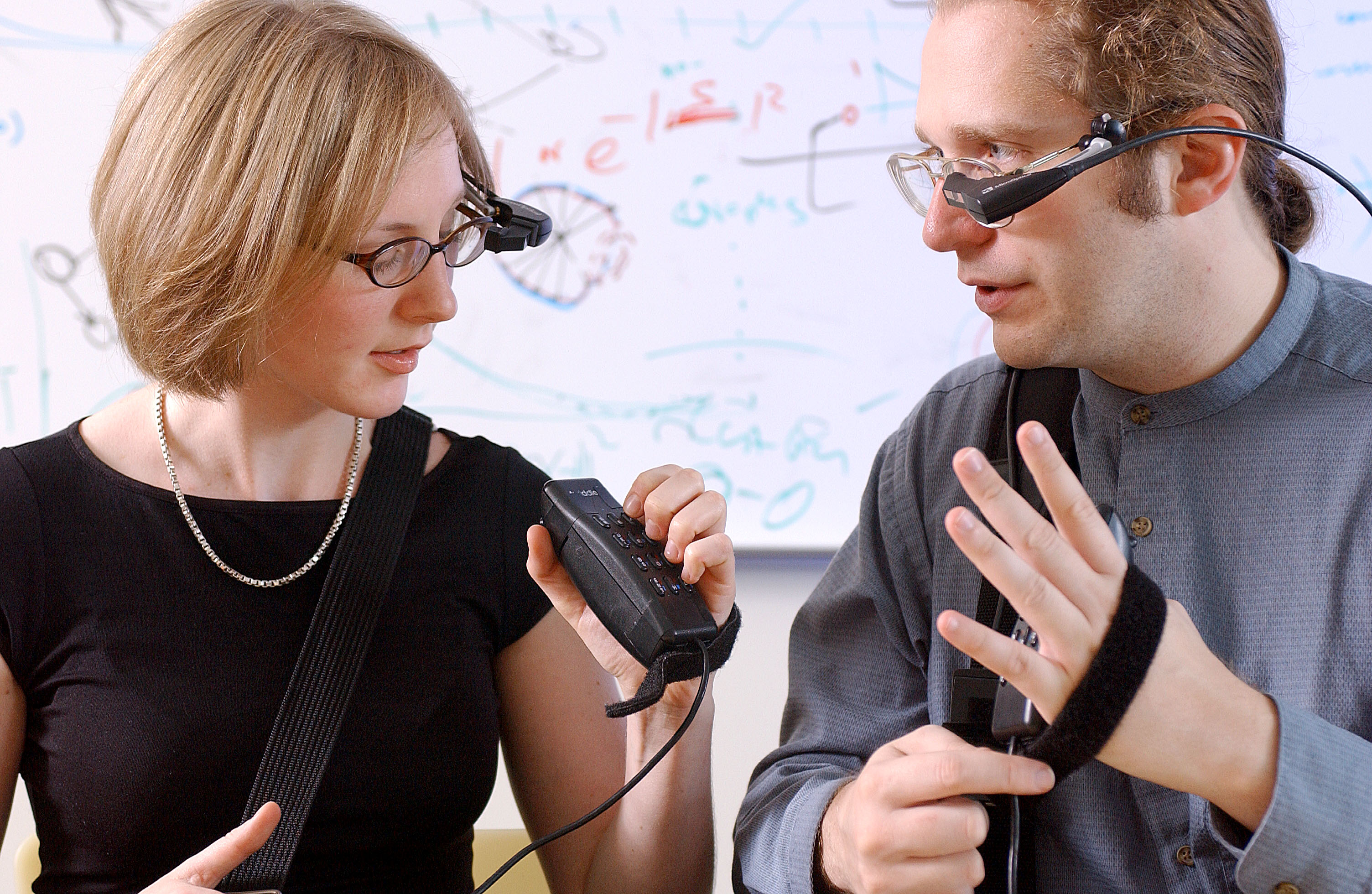
Alexander Hayes is completing a PhD on wearable technologies. He feels, in his words, that “we are on the cusp of a substantial shift in how we consider wearable technologies likely in the next 6 – 24 months … there has been a discernible shift in the “heat” generated from major consortiums now bringing to market technologies that are pervasively poised to radically re-organise what is said, done, remembered and perhaps more importantly re-wired for other parties purposes.
“Google Glass provides us all with a reason to question what it will mean to be interacting with our peers, family and loved ones through the fashion filter of a networked and location aware device. Body worn technologies such as Memoto and Autographer also join the list of data logging devices that we use to monitor and transmit data from our daily activities, either for health awareness, entertainment or myriad of other reasons.”
In this session, members of Webheads in Action, TALO, Worldbridges, and affiliated online communities and thought leaders will discuss the benefits, risks and perhaps harm that may arise with the rollout of second generation intelligent (smart) wearable technologies in our society.
…presenters and panellists will address the implications of living in smartworlds – smart grids, smart infrastructure, smart homes, smart cars, smart fridges…smart people. ISTAS’13 will bring together participants sharing research, projects, and ideas about people living in smart environments.
Assorted Resources & Articles
International Design Foundation Encyclopedia of Wearable Computing
To what extent will wearable technology play a greater part in our everyday lives in the next 6 – 24 months?
What does the onset of Google Glass, Memoto, Autographer etc. mean for our communities and society at large?
Are there any cultural apprehensions as to what these technologies may imbue and if so is this anxiety substantiated in any way?
Are there benefits in wearing a camera around all day long that takes random photos irrespective of where you are and who your with?
Given these are multi-sensor based devices that are connected to social media channels and platforms what are the implications for where the data ends up?
Given the terms and conditions of the providers who govern the use of the device ….who actually owns the data?
Is there likely to be a need to shift our current rules around social engagement, conversing with learners, our children, our friends and family if we choose to join this “revolution” in recording?
To what extent are these technologies going to benefit industries such as augmented reality or in a way that may change our current workplace engagement?
Is there any inherent considerations here that organisations, particularly educational institutions need to address before it becomes commonplace for learners whether they be virtual or physical to be recording as a cool, hip activity for their own purposes or that of others?
What is your own personal perspective on this technology mashup and is it likely we are going to see you wearing these devices in the next short while?
Alex is presenting at the IEEE International Symposium on Technology and Society, June 27-29, 2013 | Toronto, CANADA. See the following URLs for more information:
The 6th VRT conference in 4 years took place over the weekend of May 17-19, 2013. As usual, there was a stellar offering of presentations lasting most of each of three days. Brainchild of Heike Philp, the conference was completely free and online and based itself at the following URLs:
Sunday May 19 1600 GMT special unconference / barcamp / edcamp program at VLRT hosted by Heike Philp, Vance Stevens, and Arjana Blazic
Adobe recording: http://lancelot.adobeconnect.com/p3t7zoohn12/ Warning from Heike, this is a 7 hour recording (first 2 hours = unconference, last hour = ELTONS, forgot to switch off). Hopefully we’ll sort it out on the YouTube and mp3 recordings to follow.
This is copy/pasted from the program for Sunday May 19 (add 4 hours for UAE time)
In planning today’s session, I thought the topic would be the flipped classroom, so I invited someone who’s presented on that topic before, Laine Marshall, to join us. Laine is also a participant in LTMOOC. Meanwhile I’m pleased to find that I have been learning about Instreamia in flipped classroom mode, as is any participant in that MOOC engaged in learning from the tutorials. I thought it would also be interesting to discuss how we are learning on a spectrum ranging from purist cMOOC to robo-graded xMOOC, and this was touched on in the discussion.
I also invited Maria Colussa to co-host. She has appeared with us previously in Learning2gether and Electronic Village Online.












 Learning2gether