Maria Bossa presents her tools and projects to Cintia Costa’s undergraduate TEFL students
What
Maria Bossa in Argentina presented her tools and projects to Cintia Costa’s undergraduate students of Teaching English as a Foreign Language in Bahia, Brasil
Topic:Blending technologies and feedback for EFL writers
Benjamin Steward shared how he provides formative feedback to English-as-a-foreign/second language writers through the use of Canvas (by Instructure.com) and Google Drive. He also covered different ways EFL writers in his class experience feedback through a more transparent way of learning. Listen in and share with others how you approach written feedback to EFL/ESL writers!
Every week night during Connected Educator Month, join Steve Hargadon from 7:30 – 8:30 pm US-Eastern Daylight Time for an hour of online relaxed and social time with some great special guests. The recordings of our time with Dean Shareski, Vicki Davis, Larry Ferlazzo, and Angela Maiers are now available at http://bit.ly/connected_cafe, as well as are the links to join each night.
Thu Oct 10 1500 GMT – Elaine Hoter and Merja Karvinen – 1st of 2 free intercultural online exchange webinars
This series of 2 free webinars is for all teachers and lectures who have always wanted to connect with classes in other countries but it never actually worked out- this is your opportunity to learn how to collaborate with online partners, find partners for your topic area and age group and have a free social network to carry out your joint activities. The two webinars in this series will give you the tools to carry out successful sustainable online collaboration and give you insights on applications that can help with collaborative online learning. The series is supported by a Fulbright grant.
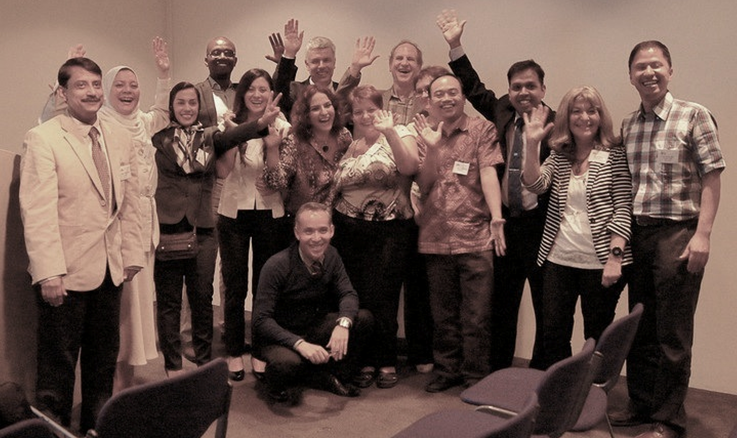
On Sunday Oct 6 2013 we enjoyed a conversation with Carla Arena and a number of other WorldCALL Scholarship Recipients
Carla Arena, Hora Hedayati, Miguel Mendoza, were in our session today. They and several others (pictured above) were recipients of WorldCALL Scholarships to attend the most recent WorldCALL in Glasgow this past summer. WorldCALL is an important event in the world of CALL, and takes place only every 5 years.
The discussion today will center on participants’ impressions of the event and delved into the mind shifts required for sharing learning with people like those pictured above, and how we guide students in learning pathways that inculcate the mindsets that enable our own learning.
A lovely conversation with Mike McKay tonight, talking about early days with Webheads, Fire Centaur, Kip Yellowjacket, English Village, and why more people don’t make use of this creative space for language learning, and for that matter, why only 10% of Mike’s students are drawn to the space, despite the contageous passion of the teacher …
What: Mike McKay runs Cyprischat, a space in Second Life where you can practice speaking English 24 hours a day for free.
Watch the video to learn more about this international English learning community at http://cyprischat.org/
I teach 4-6 classes each semester in the English department. My classes range from speaking and writing, to presentations and interactive web environments. I am not a tenured professor and do not ever intend to be one. I enjoy teaching, not writing. A student’s smile is good for the heart.”
On Friday September 27, Learning2gether facilitated breakouts from two conferences in Latin America
Ironically, neither worked out very well. Benjamin in Mexico City was doing fine with the setup but lost his Hangout just as he was starting his presentation. We had Maria ok at FAAPI but her sound cut out once she started presenting. Consequently, the video posted here is of value only as archive tokens, but we were unable to record presentations.
Hangout with Benjamin Stewart – EFL Educators Share or Perish
This event was delayed at the start and re-scheduled to begin 45 late waiting for the live audience to arrive. Elizabeth Anne and Vance were in the Hangout with Benjamin, but just as we could hear the audience coming into the room, Benjamin dropped from his Hangout. He apparently had to begin the live presentation without the Hangout as the recording appeared at his live stream at http://benjaminleestewart.blogspot.mx/p/channel.html, indicating that Google had terminated it and posted it at YouTube. The Hangout did not resume, so this is as much as we got: http://www.youtube.com/watch?v=hfRa4RM3IGg&feature=share
Benjamin Stewart wishes to invite the Learning2gether community to this TILL event (Teachers for Interactive Learning) in hopes of getting some perspective regarding what it means to share.
The format for the HOA (Hangout On Air) is 20-30 minutes of Benjamin’s presentation, followed by 20-30 minutes Q & A (or discussion). Discussions may come from face-to-face interactions and/or via the HOA.
Although the target audience is the EFL educator (pre/in-service), all educators, trainers, etc. are encouraged to participate in the discussion.
Hangout with Maria Colussa at FAAPI in Buenos Aires
María Colussa presented at the FAAPI conference in Buenos Aires (an English teachers´ big annual event) on her personal journey to become a connected educator in which EVO and the Webheads / MultiMOOC / Learning2gether communities play such an important role. She will try to be connected by twitter (#FAAPI13) and on Friday at 20:00pm GMT she will try to post a link (depending on the internet signal) to a hangout to be active for some minutes before the actual workshop. Learning2gether coordinated with her, started and streamed the hangout, but we lost sound from Buenos Aires once the presentation started.
Today’s discussion seeks to call attention to this worthy effort, to encourage you to submit a proposal soon if you haven’t done so already (about half a dozen have been received for far with several known to be in the works), and also to suggest to all others that it would be a very worthwhile investment of time to participate in EVO this January and February by following a course or two, if not actively moderating one.
Who: A discussion hosted by Vance Stevens
What: What’s going on with networked learning and how should this inform our teaching practices
These are but two (that happened to take place in the past week) in a firehose of events that have been increasing in frequency, often not weeks, but days apart. The MOOC concept, whether xMOOC or cMOOC, provides steady often overlapping opportunities for deeper, more prolonged engagement not only with niche topics, but more importantly with others interested in those niches. Google Hangouts on Air now make it possible for anyone to simulcast an event, and many do, extending invitations to colleagues in a mushroom field of communities. It seems there is something of this nature going on every minute, and social media is working virally to spread the word among educators. Stepping back to a wider perspective on this phenomenon, what is going on every minute is networked, connectivist learning.
Every minute! Open education, driven by learners connecting with other learners, is taking place around the clock, around the globe, in countless free spaces, bound only by the amount of time participants can make to engage and absorb the knowledge inherent in their networks.
So our discussion can touch on how we might rethink our role as educators, or perhaps more importantly, encourage others to follow our example. The Hangout today is another example of how participants in social networks acquire the tools for re-thinking how they engage their students.
Networked learning is ineffable in that it must be experienced to be understood, and those without that experience have difficulty grasping a full range of its affordances. As the behavior of participants in online networked learning changes, so their teaching styles change, and the better they are able to model for their students characteristics of what they find most effectively leads to their learning what they want to know in an increasingly interconnected world.
(This happens to be what Vance will be talking about at the upcoming RSCON4 conference in October, and I hope today’s discussion will help us conceptualize some of the issues to be addressed.)
What happened at the event:
This conversation was two hours long. There’s not much we can do about the YouTube video without putting in considerable effort, but I can cut the mp3 rendition into Part 1 (when most people left) and Part 2, where it was me staying out of the way of a conversation between David Weksler, Rob Perhamus, and Scott Lockman.
Nina asked in the chat if the Google+ text chat was preserved. The answer is ‘no’ unless someone ‘ding!’ copies the chat and pastes it into a text file in some reduced and meaningful form, as I have done here.
We recalled Sunday, January 15, 2012 – Super Sunday Streaming with Jeff Lebow: Hanging out in Second Life withHeike Philp, PetchaFlickr with Scott Lockman, and more
Do not forget as you walk these classic places you are here to enrich the world, and you impoverish the world if you forget the errand — Woodrow Wilson
(1913)
Two recent events alluded to in this presentation were
Wed Sept 18 1700 GMT CIDER features Terry Anderson – Exploring research issues
“In this session, Professor, former Canada Research Chair, and CIDER host Dr. Terry Anderson will overview the contents of a new open access book to be released by AU press this fall. The book overviews the major issues that researchers in online education are researching and on which they are publishing. But what are the issues that you are concerned with? Join your colleagues in some small group discussions, focussing on questions that really need research energy … Please logon to the CIDER sessions – https://connect.athabascau.ca/cidersession/ – as a “guest”. You will then be prompted for your name, and you could add your location or institution as well, if you wish.”
The Canadian Institute of Distance Education Research (CIDER) is a Centre for Distance Education research initiative at Athabasca University, Canada’s Open University. The next CIDER session is Wed Oct 2 1700 GMT
What Kinds of Learning Can We Scale with Online Resources and Activities (and what can’t we scale)?
Thomas Carey, Athabasca University
These events are free to anyone to attend.
There is no mention of recordings of these sessions at this site (that I can see)
but more content is available to those who can log onto the site with one of the following credentials
September 19-21, 2013 – Global 2013 STEMx Education Conference
the Global 2013 STEMx Education Conference, the world’s first massively open online conference for educators focusing on Science, Technology, Engineering, Math, and more. The conference will be held over the course of three days, September 19-21, 2013, and will be free to attend!
STEMxCon will be a highly inclusive event that will engage students and educators around the globe and will encourage primary, secondary, and tertiary (K-16) educators around the world to share and learn about innovative approaches to STEMx learning and teaching. The call for presentations has been issued. More information below.
Please register at http://www.stemxcon.com to attend and to be kept informed
Co-hosted with Jim Buckingham (TAEdTech, Tesol Arabia EdTech SIG)
Opening discussion on
1) TAEDTECH Sig – An Introduction
We will provide a short introduction on the TESOL Arabia Education Technology – Special Interest Group(now you know why we use an acronym). This will include a short history, a review of its current mission and an intro into the PD opportunities if affords for those prepared to get involved and make a difference.
This should lead into a discussion on where the Group can and should be heading. Vance Stevens will take the view that it should be promoting more global connections for EFL educators. Jim Buckingham will take the view that it needs to provide a predominantly regional focus for EFL educators in the region. Both Vance and Jim will invite others to help present their views.
In this event, Vance Stevens and Jim Buckingham engage in a mock debate. Jim and I both work in the UAE and we are both active in TAEdTech SIG (TESOL Arabia EdTech SIG, based in the Arabic region). Jim is promoting integration of Learning2gether with TAEdTech and he will argue the importance of doing that with emphasis on the local context while I will be emphasizing the importance of integration with a more global context.
The debate has relevance because many here (and in many contexts) tend to focus on their local situation and treat global outreach as a distraction. Jim doesn’t feel that way but he might argue that practically speaking, a localized chapter of a global organization should be focused more inward than outward. I might argue that outward focus would create conditions for attracting a critical mass of participants. Either side could be right. Come and join the debate.
This discussion was postponed to a later opportunity
2) PDPs: why bother?
In support of TAEDTECH’s monthly theme – PDPs – why bother?we will take a quick look at what exactly a PDP(Professional Development Plan) is and why you might be interested in realizing one. We will look at who is promoting their use, the rational for their use, the frameworks used to help realize them, and relevant examples.
PLN Show and Tell was intended to be co-hosted with Benjamin Stewart (TILL, Teachers for Interactive Language Learning) Sunday September 8 2013 at 1400 GMT but Benjamin got sick and had to bow out; however the Learning2gether community gathered largely thanks to notices being disseminated by Google+ communities, an illustration of PLN in action
In Hangout: What does your PLN currently look like? How do you manage it, and why?
The conference has also been made into a course to help participants receive the ongoing updates on the conference. The course will remain active after the conclusion of the conference to enable participants to exchange views. Enroll into the course right away to get updates and join the discussions with other participants of MMVC13.
We are in a paradigm shift where ongoing learning is moving from the scarcity of what many of us could once only find through degree programs and flying off to international conferences, to the over-abundance of what is available online through MOOCs and webinars and countless online events and communities. This abundance caters to all learning styles, the only seeming limitation being what we can steer our way and then filter so that we can make some sense of the most useful droplets of knowledge streaming from the fire hose. What is abundantly possible is limited only by scarcities in time, energy, and attention.
Learning2gether http://learning2gether.net tries to keep a finger on the pulse of some of this activity. In so doing we connect with other networks and communities of networks, including the ones putting on this online event. This presentation will connect with others in these networks and discuss some of the balances of abundance and scarcity that enhance and limit the opportunities we are now finding online.
The above session followed one by Nellie Deutsch
MMVC13 at 1300 GMT: WizIQ on Moodle with Dr. Nellie Deutsch
Teaching Blended Online Learning (BOL) using Moodle & WizIQ by an expert e-learning teacher. The presentation will focus on teaching fully online in both synchronous live online classes on WizIQ and using Moodle. Dr. Deutsch has been using Moodle since 2003 and WizIQ since 2007. She has acquired a great deal of experiences in online teaching and trains teachers around the globe.
For the record, another presentation I was very much interested in from this conference …
Cintia and her students charmed us with their approach to learning language based on avoiding textbooks in favor of freeing students to express themselves using creative technology tools on topics they were passionate about. Three of Cintia’s students joined us online to corroborate the success of Cintia’s highly motivating contexts for learning.
Cintia writes: In order to show our support to the uprisings and demonstrations for better public services and against corruption that took place all over Brazil in June 2013, my undergraduate students of Teaching English as a Foreign Language and I decided to create a different kind of protest in the Brazilian Amazon. We created a video in which we made our voices heard and stated our demands on the public services we think we deserve as citizens. To share this experience with you, we are presenting all the steps of this innovative project. You can find the link to the video in my blog: http://learnenglishwithcintia.blogspot.com.br/2013/06/aprendendo-e-fazendo-historia-com-meus.html





 Learning2gether